Corpus Hermeticism: What the Ancient Texts Actually Are
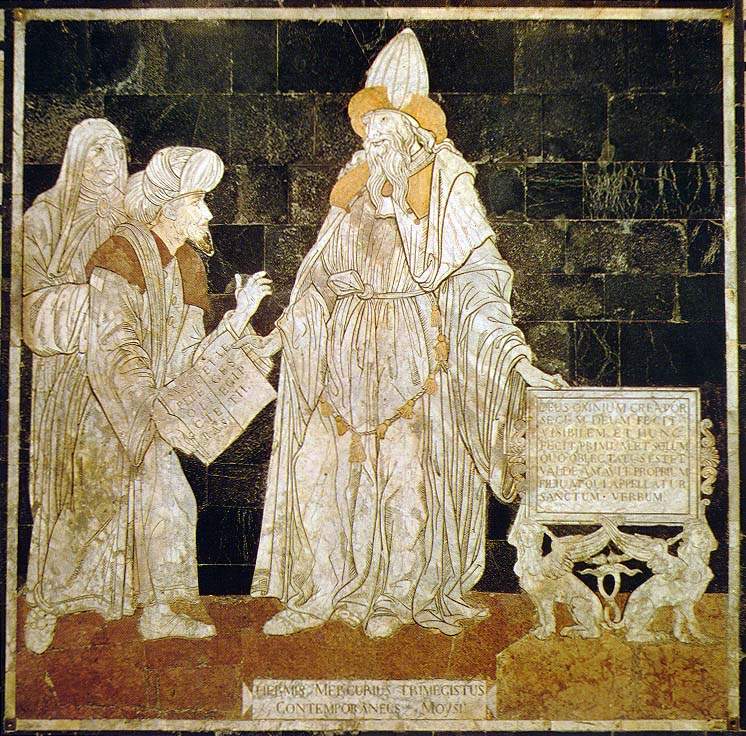
The search phrase "corpus hermeticism" nearly always points to one specific thing: the Corpus Hermeticum, the collection of seventeen Greek-language treatises attributed to Hermes Trismegistus that forms the actual textual foundation of Western Hermeticism. It is not a separate school or a modern movement. It is the body of ancient writing that every later hermetic philosophy — the Renaissance revival, the occult societies of the nineteenth century, even the Kybalion's seven principles — claims some lineage back to, whether or not the claimed connection survives close historical scrutiny. What follows is what those seventeen texts actually contain, how a manuscript almost lost to history reached the Renaissance, and why one scholar's dating of them in 1614 changed how the West understood its own intellectual past.
What "Corpus Hermeticism" Actually Points To
"Hermeticism" names the broad philosophical and spiritual current that grew out of writings credited to Hermes Trismegistus across more than two thousand years — Renaissance Hermeticism, nineteenth-century occult Hermeticism, the mystery-school reading of it that continues today. "Corpus Hermeticum," Latin for "the body of Hermes," names one specific object inside that larger current: the set of seventeen Greek treatises scholars treat as the philosophical core of the whole tradition. The blended search term usually comes from someone reaching past general summaries toward the primary source itself. That instinct is sound. Nearly everything called "Hermetic philosophy" today traces, rightly or loosely, back to these seventeen texts, together with a companion work, the Asclepius, which survives only in Latin. Scholars group both under a wider umbrella called the Hermetica, which also includes shorter fragments preserved by the fifth-century anthologist Stobaeus.
Hermes Trismegistus and the Seventeen Treatises
The collection opens with its most studied text, the Poimandres, a vision in which a being identifying itself as Nous, or divine Mind, appears to the narrator and unfolds how mind gave rise to the cosmos, how a portion of that mind descended into matter as the human soul, and how the soul ascends again by shedding, sphere by sphere, the traits that bind it to the material world. The sixteen treatises that follow are mostly framed as dialogues — Hermes instructing his son Tat, or the physician-philosopher Asclepius, or a seeker named Ammon — on subjects ranging from the nature of God and the soul to fate, generation, and the relationship between the visible cosmos and the mind that produced it. Their recurring claim, later distilled into the single sentence "the All is Mind," treats the material world as a genuine but lower expression of one underlying intelligence rather than a separate, mechanical system. One line from the opening vision gives a sense of the tone: "I, Mind, myself, am present with the holy and the good, the pure and the merciful, men who live piously," reads a common English rendering of Poimandres — closer to philosophical theology than to spell or formula.
How a Nearly Lost Manuscript Reached Renaissance Florence
For roughly a thousand years after antiquity, the Corpus Hermeticum survived mainly through Byzantine hands. The eleventh-century philosopher Michael Psellos is credited with preserving and copying Greek manuscripts of it at a time when much of the ancient philosophical library had already been lost to fire, war, and simple neglect. The text reached Western Europe only around 1460, when a monk named Leonardo da Pistoia carried a Greek manuscript back from Macedonia to Florence. Cosimo de' Medici, who had commissioned the scholar Marsilio Ficino to translate the complete works of Plato, instead ordered him to set Plato aside and translate this manuscript first. Ficino finished a Latin version, known as the Pimander, in 1463.
Ficino and nearly every one of his contemporaries believed Hermes Trismegistus to be an Egyptian sage who had lived before Moses — a link in what Renaissance humanists called the prisca theologia, an "ancient theology" they believed had anticipated and confirmed Christian revelation across many cultures. That belief, mistaken as it turned out to be, drove an extraordinary wave of influence: Pico della Mirandola wove Hermetic ideas into his philosophy of human dignity, and Giordano Bruno built an entire cosmology partly on Hermetic foundations. For well over a century, these seventeen Greek dialogues were read in Western Europe as some of the oldest wisdom literature in existence.
The Dating That Undid Four Centuries of Belief
In 1614, the Swiss philologist Isaac Casaubon examined the Corpus Hermeticum's own Greek vocabulary and philosophical content and demonstrated something the text's champions had never considered: its language and ideas belonged to the early centuries after Christ, drawing on Platonism and Stoicism that did not exist in the age of Moses. The texts, Casaubon showed, were almost certainly composed in Roman Egypt, likely in the intellectual milieu of Alexandria, by authors who never claimed the name Hermes Trismegistus for themselves in any literal sense. The finding carried real stakes beyond scholarship — it undercut a claim Catholic apologists had leaned on during the Reformation, that ancient pagan wisdom independently confirmed Christian truth, which made Casaubon's Protestant allegiance part of the story as much as his philology. What the redating did not do was end the tradition's influence. Hermetic ideas kept circulating through alchemy, Rosicrucian writing, and later the occult revival of the nineteenth century, carried now as a philosophy worth studying on its own terms rather than as proof of a vanished golden age.
Why Corpus Hermeticism Still Shapes Esoteric Study Today
Strip away the question of authorship and the texts still do something unusual: the Poimandres stages its opening vision as an event that simply happens to its narrator, unasked, while his senses are at rest — closer to what a modern reader would call a spontaneous spiritual awakening than a result of any described technique. Mind arrives uninvited and the narrator is, in the text's own terms, abruptly awake to a structure of reality he had not seen a moment before. That same pattern — a thinning boundary, an opening that was not scheduled or earned — is exactly what later writers in this tradition keep describing when they talk about waking up spiritually, two thousand years and a different vocabulary apart. Initiates who study the seventeen treatises directly, rather than through later summaries, tend to come away less interested in who Hermes Trismegistus actually was and more struck by how precisely a text this old anticipated a kind of inner event people are still trying to describe today.
Walk the Path of the Initiate
These teachings come alive in The Initiated — Paul Schulz's introduction to the living mystery school tradition.
Get the BookFrequently Asked Questions
What does "corpus hermeticism" actually mean?
It is a search-term blend of two related ideas: the Corpus Hermeticum, the collection of seventeen Greek treatises attributed to Hermes Trismegistus, and Hermeticism, the broader philosophical tradition built on them. People typing the phrase are almost always looking for the ancient texts themselves rather than a separate school of thought.
How many books make up the Corpus Hermeticum?
Seventeen treatises survive under that title in the Greek manuscript tradition, opening with the Poimandres. A closely related text, the Asclepius, survives only in Latin and is usually studied alongside the Corpus Hermeticum rather than counted inside it, together forming what scholars call the Hermetica.
Who actually wrote the Corpus Hermeticum?
No verifiable author's name survives. The texts are presented as teachings from Hermes Trismegistus, but scholars date their composition to the first few centuries after Christ, written by unknown Greek-speaking authors in Roman Egypt who drew on Platonist, Stoic, and Egyptian religious ideas.
Is the Corpus Hermeticum the same as the Emerald Tablet?
No. The Emerald Tablet is a separate, much shorter text that first appears in Arabic alchemical writing centuries later and was never part of the Greek Corpus Hermeticum. Both are credited to Hermes Trismegistus, and both shaped later Hermetic philosophy, but they come from different manuscript traditions and different eras.
Why did Isaac Casaubon's dating of the texts matter so much?
In 1614, Casaubon used the texts' own Greek vocabulary and ideas to show they were written in the early Christian era, not by an ancient Egyptian sage older than Moses as Renaissance scholars believed. The finding undercut a central claim used to argue Hermetic wisdom validated Christian revelation, though it never stopped the tradition's long influence on later esoteric thought.