Hermetic Alchemy: What the Tradition Actually Teaches About Inner Transformation
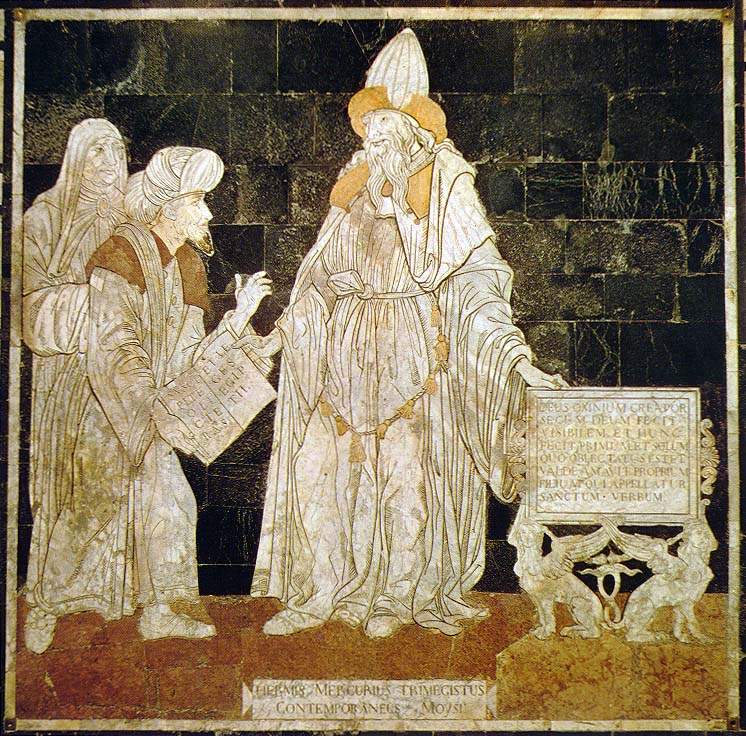
Hermetic alchemy is the current within Western esoteric tradition that reads the alchemical Great Work — the turning of base metal into gold — as a symbolic account of the soul's own transmutation, not a laboratory procedure. It traces its authority to Hermes Trismegistus, treats the furnace and the vessel as images of inner discipline, and survives today less as a chemistry than as a structured claim about how consciousness purifies and reorganizes itself. To understand it is to stop asking whether the old alchemists actually made gold, and start asking what they meant by the word.
What Hermetic Alchemy Actually Means
The word "hermetic" does not simply mean secretive, though that popular sense derives from it. It refers specifically to Hermeticism, the philosophical system attributed to Hermes Trismegistus and built on a small set of governing principles: that mind precedes matter, that the small mirrors the large, that everything moves in rhythm and polarity, and that nothing happens without a cause. Alchemy, in this framework, is not an isolated craft. It is one of three classical hermetic arts — alongside astrology, which reads the correspondence between heaven and human affairs, and theurgy, the ceremonial work of aligning with higher intelligence. Alchemy's particular office is transformation itself: the doctrine that a substance, a state of mind, or a life can be broken down, purified, and reconstituted at a higher order.
Initiates describe alchemy in exactly these terms — as the art of raising vibration and transmuting consciousness, of burning away what no longer serves so that something more refined can take its place. That framing matters, because it draws a hard line between hermetic alchemy and the popular image of a robed figure hunting for a get-rich-quick formula. The tradition holds that the real gold was never metal.
Hermes Trismegistus and the Roots of the Art
Every strand of hermetic alchemy runs back to the same disputed source: Hermes Trismegistus, "Thrice-Great Hermes," a legendary sage merging the Greek god Hermes with the Egyptian Thoth, credited with founding the whole family of hermetic sciences. The foundational text attributed to him, the Emerald Tablet, compresses the entire doctrine into a single, famous line of correspondence:
"That which is below is like that which is above, and that which is above is like that which is below, to accomplish the miracle of the one thing."
That single sentence is the hinge on which hermetic alchemy turns. If the below truly mirrors the above, then a process performed on lead and mercury can be a genuine description of a process happening in the soul — not a loose metaphor tacked on afterward, but the same law working at two scales. The tradition holds that this teaching predates its written record by thousands of years, carried first as oral instruction from master to student long before it was set down as text, which is part of why so much of the literature reads as deliberately layered: plain enough to describe a workshop, deep enough to describe a life.
The Tria Prima: Sulphur, Mercury, and Salt
By the Renaissance, hermetic alchemy had developed a working vocabulary that any student of the literature has to learn, and the physician-philosopher Paracelsus gave it its clearest form in the tria prima, the three first principles. Sulphur named the soul's volatile, combustible essence — desire, will, the active spark. Mercury named the connecting spirit, the fluid intelligence that carries information between extremes. Salt named the fixed, embodied structure — the body, the crystallized result. The work these texts describe is not a recipe for combining three chemicals; it is an account of bringing these three forces of a human being into right relationship, so that will, intelligence, and embodiment stop working against each other.
The literature that carries this vocabulary is vast and often deliberately obscure: the Twelve Keys attributed to the Benedictine monk Basilius Valentinus, Michael Sendivogius's letters on the "true philosophical stone," the later synthesis of Fulcanelli, and dozens of earlier tracts on the elements, the "red lion," and the philosopher's stone. Read individually, these texts can look like fragments of failed protoscience. Read as a body of work, they show something more consistent: a centuries-long argument, conducted almost entirely in allegory, that the properties of matter and the states of the human soul answer to the same underlying grammar.
The Twelve Keys themselves make this explicit in their own framing. Each "key" was presented as a stage of the philosopher's stone's production, yet the text is equally clear that these are not instructions for a chemical experiment so much as symbolic markers along a path of purification — each one naming a threshold the practitioner's own character had to cross before the language of the next key made any sense.
From Furnace to Psyche: Why the Work Turned Inward
Historians of ideas have long noted the split running through the alchemical record between operative alchemists, who genuinely worked with furnaces, minerals, and distillation, and the hermetic current, which used the same imagery to describe an entirely inner discipline. Hermetic alchemy is squarely the second stream. It treats the "prima materia," the raw and unrefined starting matter every text insists the work must begin with, as the ordinary, unexamined self: reactive, mixed, ruled by pattern and habit rather than by will. The stages traditionally named — blackening, whitening, reddening — describe, on this reading, a sequence of psychological confrontation, clarification, and integration, not a color change in a crucible.
This is also where hermetic alchemy overlaps most directly with the wider work of healing and consciousness that the mystery schools teach. The same language of purification and transmutation shows up in work on the body's energetic field, where imbalance and impurity in the aura are treated the same way alchemy treats base matter — as something to be cleared and refined rather than punished or feared. It also anticipates, by centuries, what modern research is only now beginning to describe from the outside: measurable differences in the brains of people oriented toward sustained spiritual practice, evidence that a real, structural transformation can follow from disciplined inner work, however that work is named.
Hermetic Alchemy in the Mystery School Tradition Today
Modern mystery school teaching does not present hermetic alchemy as an antique curiosity to be studied and shelved. It presents alchemy and metaphysics as a working pair: alchemy supplying the doctrine of transformation, metaphysics supplying the wider view of reality above pure physicality that makes such transformation intelligible in the first place. Teachers in this lineage describe healing itself as an alchemical process — the movement from a lower, contracted state into a freer one, achieved through the same pattern of confronting, releasing, and reconstituting that the old texts describe in the language of metals and fire.
None of this promises an easy or automatic result; the tradition is explicit that the work is demanding precisely because it asks a person to face what is unrefined in themselves rather than looking away from it. What hermetic alchemy offers instead is a coherent, very old vocabulary for a claim that keeps resurfacing across very different traditions and centuries: that a human being is not fixed, that base material — mineral or psychological — can be genuinely changed in kind, and that the changed result is worth more than what it started as. That is the "gold" the tradition has always meant.
Walk the Path of the Initiate
These teachings come alive in The Initiated — Paul Schulz's introduction to the living mystery school tradition.
Get the BookFrequently Asked Questions
What is hermetic alchemy, in simple terms?
Hermetic alchemy is the branch of Western esoteric tradition that reads alchemical language — furnaces, metals, the marriage of opposites — as a symbolic map of the soul's transformation, grounded in the philosophy attributed to Hermes Trismegistus.
Is hermetic alchemy the same thing as trying to make gold?
No. A literal, metallurgical alchemy did exist historically alongside the symbolic tradition, but hermetic alchemy proper treats gold and the Philosopher's Stone as figures for a perfected, integrated consciousness, not a financial outcome.
Who are the key figures in hermetic alchemy?
The literature runs from the legendary Hermes Trismegistus and the Emerald Tablet through medieval and Renaissance authors such as Basilius Valentinus, Paracelsus, and Michael Sendivogius, into later commentators like Fulcanelli who read the older texts symbolically.
What do sulphur, mercury, and salt represent in hermetic alchemy?
In the tria prima attributed to Paracelsus, sulphur represents the soul's volatile, active essence, mercury the connecting spirit or fluid intelligence, and salt the fixed, embodied structure — three principles the work seeks to bring into right relationship, not three substances to combine in a vessel.
Does the mystery school tradition still teach hermetic alchemy today?
Yes. Modern mystery schools present alchemy as a living principle of transformation, working alongside disciplines such as Kabbalah and sacred geometry, and framed as a tool for consciousness and healing work rather than a historical curiosity.