Hermeticism Emerald Tablet: What the Text Actually Says
The phrase "Hermeticism emerald tablet" usually sends a searcher toward a single short text: the Emerald Tablet, a document of only a dozen or so lines, attributed to Hermes Trismegistus, that became the founding scripture of Western Hermetic philosophy and gave the world its most quoted line of esoteric thought, "as above, so below." The tablet is not a long treatise. It reads almost like a riddle, compressed and deliberately resistant to a casual read. And yet for roughly a thousand years, almost every serious alchemist, philosopher, and occult student in the Western world treated it as a kind of master key — a single sentence capable of unlocking every other door in the house of hidden knowledge.
The Legend Behind the Text
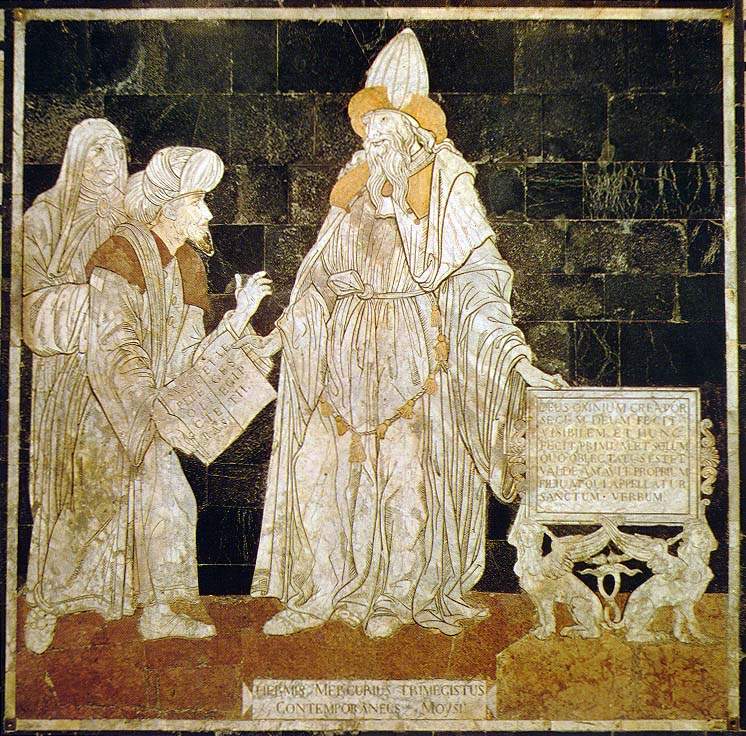
Tradition places the Emerald Tablet's origin in ancient Egypt, in the hands of a figure the old hermetic schools called "the Master of Masters." Egyptian memory identified him with Thoth, the scribe of the gods; Greek memory later called him Hermes and gave him the title Trismegistus, "the thrice-great." Whether such a man ever lived as a single historical person is impossible to settle, and the tradition itself treats the question as beside the point. What matters, in the Hermetic reading, is that the name became a vessel for an unbroken current of teaching — the father of astrology, the discoverer of alchemy, the source to which every later initiate traced their lineage, whatever land or century they were born into.
The legend of the tablet itself follows this same pattern. Medieval accounts describe a slab of green stone, inscribed in an ancient tongue, sealed inside Hermes's tomb and later recovered by a seeker determined enough to find it — in some versions Alexander the Great, in others a wandering philosopher named Balinus. None of this should be read as a claim of literal archaeology. It is the kind of origin story every tradition that values secrecy tells about its most prized text: hidden, guarded, found only by one ready to receive it. The tablet's real history, the one historians can actually trace through manuscripts, is both humbler and more interesting.
What the Emerald Tablet Actually Says
Stripped of ornament, the tablet makes a small number of claims, each stated as if it were self-evident once seen. It opens by insisting that it speaks the truth, "without any lies, certain, and most true." It then states its central axiom, usually rendered in English as something close to this seventeenth-century translation:
"That which is below is like that which is above, and that which is above is like that which is below, to accomplish the miracles of one thing."
From there the text describes a single process: something subtle separating from something gross, rising and descending, drawing power from above and below until "the whole world" is present within it. The sun is called its father, the moon its mother; the wind carries it in its belly, the earth is its nurse. Read literally, as a chemistry manual, this is nearly useless — which is exactly why generations of alchemists insisted it was never meant to be read literally. Read as the Hermetic tradition has always read it, the tablet is describing one operation playing out at every level of reality at once: cosmic, chemical, and psychological. The "one thing" it accomplishes is unity recovered after apparent separation, a theme that recurs across nearly every initiatory tradition under different names.
How a Short Arabic Text Became Western Philosophy's Founding Document
The manuscripts historians can actually date tell a more grounded story than the legend does. The earliest surviving versions of the Emerald Tablet appear in Arabic, embedded in works from the eighth and ninth centuries such as the Kitab Sirr al-Khaliqa, "The Book of the Secret of Creation," itself presented as older material gathered and preserved by Arabic scholars during a period when Baghdad's translators were rescuing and expanding on Greek, Egyptian, and Persian learning that might otherwise have been lost entirely. These Arabic alchemists did not treat the tablet as a curiosity; they built entire systems of natural philosophy around its central claim of correspondence between higher and lower orders of existence.
The text reached Latin Europe in the twelfth century, carried along with the broader wave of Arabic scientific and philosophical works that scholars in Spain and Sicily translated during that century's great transfer of knowledge. Once in Latin, it spread quickly through the alchemical literature of the high Middle Ages and the Renaissance, appearing in commentary after commentary, each generation of philosophers adding its own gloss. By the seventeenth century the tablet had reached even the circle of Isaac Newton, who copied out his own English translation of it by hand among his private alchemical papers — a detail that still surprises people who know Newton only as the author of the Principia. The tablet's influence did not end with the formal collapse of alchemy as a respectable science; it simply migrated into the esoteric and occult revival movements of the nineteenth and twentieth centuries, where it remains a reference point to this day.
The Seven Hermetic Principles and the Kybalion's Debt to the Tablet
The clearest modern descendant of the tablet's teaching is a slim book published in 1908 by three anonymous authors identifying themselves only as "Three Initiates": The Kybalion. The book presents itself as a modern restatement of ancient Hermetic philosophy, organized around seven principles — mentalism, correspondence, vibration, polarity, rhythm, cause and effect, and gender. Scholars of esotericism have long noted that the book's language and structure owe more to nineteenth-century New Thought than to any verifiable ancient Egyptian source, and the tradition itself is honest that The Kybalion is an interpretation, not a rediscovered original.
What is not in dispute is how directly its centerpiece draws on the Emerald Tablet. The Principle of Correspondence, stated as "as above, so below; as below, so above," is the tablet's own axiom restated almost word for word, then expanded across physical, mental, and spiritual planes of existence. The other six principles can be read as an attempt to spell out, in plainer modern language, what the tablet only gestures at in a handful of compressed lines: that everything moves rather than rests, that every force has its opposite pole, that nothing happens outside of law, that creation itself depends on a tension between complementary forces. Initiates who study both texts side by side tend to conclude that the tablet is the seed and the Kybalion is one later generation's attempt to grow it into a fuller teaching, suited to readers who no longer had direct access to oral transmission.
Reading the Tablet as the Tradition Reads It
The mistake most newcomers make with the Emerald Tablet is treating it as a cryptic formula to be decoded and used. The tradition reads it instead as a description of an inner process that has to be lived through, not studied around. The tablet's imagery of something subtle separating from something gross, rising, falling, and only then reunited into a single, more powerful substance, maps closely onto the language the Christian mystical tradition uses for its own dissolution-and-reunion crisis — the kind of stripping-away that John of the Cross, writing four centuries later, called the dark night and treated not as despair but as a necessary passage toward union. Both texts describe the same movement: something comes apart before it can be rebuilt on a higher order.
The tablet's deeper claim — that the pattern above and the pattern below are, at root, the same pattern expressed at different scales — is also not a uniquely ancient intuition. It is the same insight twentieth-century teachers spent entire careers trying to restate in language a modern audience could actually hear. Alan Watts's teaching on waking up, for instance, rests on a structurally identical claim: that the apparent separation between self and universe dissolves once you see clearly enough, because the "self" was never really a thing apart from the whole to begin with. The vocabulary changes by century and by culture. The structure of the insight does not.
This is why initiates keep returning to a text this short. The Emerald Tablet does not reward someone looking for a technique. It rewards someone willing to sit with a single compressed claim — that above and below, inner and outer, spirit and matter, are one continuous fabric rather than two separate realms — until that claim stops being an idea they hold and starts being a way they actually see.
Walk the Path of the Initiate
These teachings come alive in The Initiated — Paul Schulz's introduction to the living mystery school tradition.
Get the BookFrequently Asked Questions
What does "as above, so below" actually mean?
It states the Hermetic claim that the pattern governing the higher, invisible orders of existence is the same pattern that governs the lower, visible one. A single law repeats at every scale, from the movement of stars to the movement of a single thought, so understanding one level gives real insight into the others.
Who actually wrote the Emerald Tablet?
No author's name survives. Tradition credits Hermes Trismegistus, a legendary teacher the Egyptians identified with Thoth and the Greeks identified with their own god Hermes, but the earliest texts historians can verify are Arabic works from the eighth and ninth centuries, themselves presented as translations of something far older.
Was the tablet really carved from emerald?
Almost certainly not as a literal mineral object. Medieval legend described a green stone inscribed by Hermes himself and hidden in his tomb, but no such artifact has ever surfaced. "Emerald" in the title most likely signals the text's value and its association with a green, living, generative quality rather than a literal gemstone.
How is the Emerald Tablet connected to the Kybalion?
The Kybalion, published in 1908 by three anonymous initiates, presents seven Hermetic principles it claims distill the older teaching attributed to Hermes Trismegistus. Its Principle of Correspondence, "as above, so below," is a direct restatement of the tablet's central axiom, and several other principles elaborate ideas the tablet only hints at in a few lines.
Is the Emerald Tablet part of any religion?
No single religion claims it. It circulated among Arabic alchemists, then European alchemists and philosophers across Christian, Jewish, and Islamic contexts, prized as philosophy and natural science rather than scripture. Hermeticism itself has always run alongside established religion rather than inside it.