Hermeticism Philosophy: What the Tradition Actually Claims About Reality
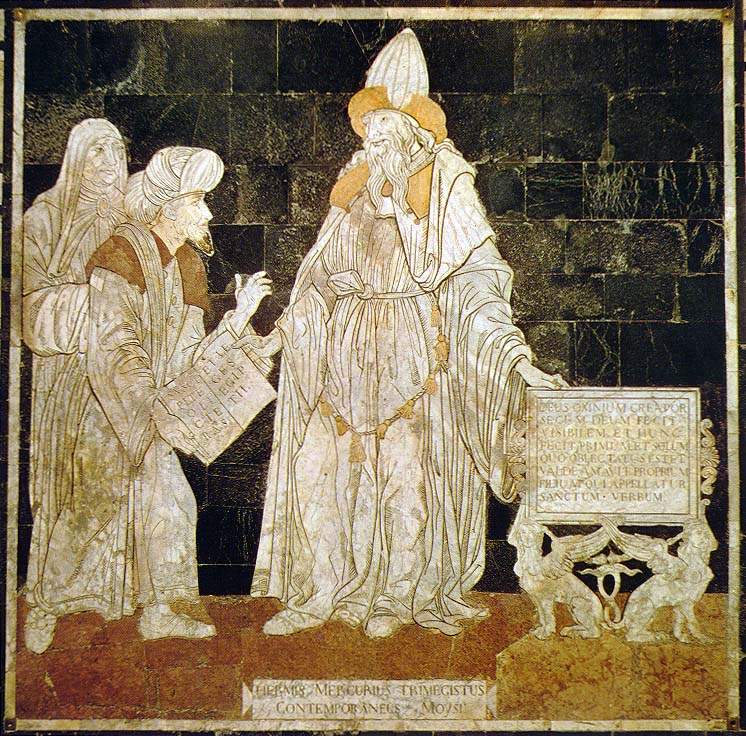
Hermeticism philosophy is the metaphysical claim, attributed to Hermes Trismegistus, that the universe is fundamentally mental: a single infinite Mind within which everything that exists, matter included, exists the way a thought exists within a thinker. That one axiom is the root from which the tradition's entire account of reality grows — its doctrine of correspondence between the small and the great, its account of cause and effect, and its promise that the human soul can come to know, and eventually rejoin, the source it emerged from. What follows is not the tradition's popular seven-principle summary but the philosophical argument underneath it — where the claim came from, what company it kept among the ancient schools, and how it is still taught as a living metaphysics rather than a historical curiosity.
The Metaphysical Claim at the Center: All Is Mind
The founding vision of hermetic philosophy is preserved in the opening treatise of the Corpus Hermeticum, the Poimandres, in which a figure identifying himself as Mind itself appears to the narrator and declares that Light and Mind, not fire and water, are the true first principles of the cosmos. Everything that exists, on this account, is a modification of one substance — Mind — rather than an assembly of independent physical parts governed by blind mechanism. This is why the tradition later distilled its whole philosophy into a single sentence: "THE ALL is MIND; the Universe is Mental." Read as metaphysics rather than slogan, the claim resembles what modern philosophers would call idealism: the view that mind is not produced by matter but is instead the more fundamental reality, with matter appearing as its lowest and slowest expression.
From this single premise, the rest of hermetic philosophy follows by a kind of inner logic rather than by separate, unrelated rules. If all is Mind, then patterns visible in one register of reality must echo in every other register, since there is finally only one substance for a pattern to occur in — hence the principle of correspondence, "as above, so below." If all is Mind, then nothing is inert, since mind is inherently active — hence the principle of vibration. The famous seven hermetic principles are not seven separate claims bolted together; the tradition holds they are seven consequences of one claim, unfolding the way theorems unfold from a single axiom in geometry.
Hermeticism's Place Among the Ancient Philosophies
Hermetic philosophy did not appear in isolation. It crystallized in Greco-Roman Egypt, chiefly in Alexandria, sometime between the first and third centuries CE, in a milieu where Egyptian temple religion sat beside Platonism, Stoicism, and Neopythagorean mathematics, and scholars still debate how much of it is Egyptian in substance dressed in Greek philosophical language, and how much is Greek philosophy borrowing an Egyptian name for authority. Its debt to Plato is visible everywhere: the Hermetic Nous, the divine Mind that generates and orders the cosmos, plays a role close to Plato's Demiurge, and the Hermetic ladder of ascent back toward the One echoes the ascent described in Plato's own dialogues. From Stoicism it absorbs the idea of a rational principle, a logos, pervading and governing the whole of nature.
Its closest and most instructive relative is Gnosticism, which arose in the same period and shares the vocabulary of gnosis, direct inner knowing rather than secondhand belief. The two part ways on a crucial point. Classical Gnostic systems generally treat the material world as a mistake or a prison, the work of a flawed lesser god, from which the spirit needs to escape entirely. Hermetic philosophy takes the more affirming position: matter is a real and legitimate, if lower, expression of the one Mind, worth studying and working with rather than fleeing. That difference is not a technicality. It shapes everything downstream — whether a philosophy asks its student to withdraw from the world or to master it from within.
The Renaissance Revival: Ficino, Pico, and the Return of Hermetic Philosophy
For roughly a thousand years after antiquity, hermetic philosophy survived mainly through Arabic alchemical and astrological texts and a handful of Latin fragments. Its return to Western philosophy came in 1463, when Cosimo de' Medici handed the Florentine scholar Marsilio Ficino a manuscript of the Corpus Hermeticum and asked him to set aside his work on Plato to translate it first. Ficino, and most of his contemporaries, believed Hermes Trismegistus to be an Egyptian sage who predated Moses — part of a chain of ancient theology, a prisca theologia, that they thought anticipated and confirmed Christian revelation. That belief turned out to be historically mistaken; philological work three generations later showed the Corpus Hermeticum was written in the Christian era, not before it. But the philosophical content Ficino had unleashed into Renaissance thought was already loose and already influential.
Pico della Mirandola went further still, weaving hermetic ideas into his 1486 Oration, the text now remembered as the founding document of Renaissance humanism, and into his broader project of Christian Kabbalah, which held that hermetic, Kabbalistic, and Christian philosophy were compatible expressions of one underlying truth. Giordano Bruno carried a version of this hermetic cosmology into his own controversial cosmology of an infinite universe animated by a single mind. Even Isaac Newton, two centuries later, spent years translating and annotating hermetic and alchemical manuscripts alongside his work on physics, treating them as a serious philosophical inquiry rather than a curiosity.
Philosophy, Not Doctrine: How Hermeticism Claims to Know
What separates hermeticism philosophy from a creed is its account of how a person comes to know its claims are true. The tradition does not ask for belief on authority; it points toward gnosis, a direct inner recognition, arrived at through disciplined inner work rather than argument or scripture. This is why the Kybalion opens with a warning rather than a proclamation: "The lips of wisdom are closed, except to the ears of Understanding." The line is not gatekeeping for its own sake. It states a philosophical position — that certain truths about mind cannot be transmitted as information, only occasioned, the way a teacher can point at the moon but cannot hand a student the act of seeing it.
That is also why the tradition resists being folded into any single religious institution, a caution the old teachers stated explicitly: hermetic philosophy is found within many religions across history, but the schools that survived longest were the ones that never let the philosophy calcify into a fixed creed administered by priests. Where that happened, the historical record shows, the deeper philosophical content tended to erode into superstition within a few generations. Hermetic philosophy, by design, keeps itself a living inquiry rather than a settled dogma.
How the Mystery School Tradition Still Teaches Hermetic Philosophy Today
The lineage I was trained in treats hermetic philosophy less as a subject to study than as an instrument to use. Meditation, sacred geometry, and the graded structure of initiation itself, the same graded transmission that shaped every school discussed in Ancient Mystery Schools: What Each One Actually Taught and How It Initiated Members, all rest on the same founding premise: that the mind, rightly trained, can perceive the correspondences the philosophy describes rather than merely reciting them. A student does not memorize that vibration is universal; a student learns, through sustained inner practice, to feel it. That same premise underlies why practices like spiritual healing are taught as a direct application of hermetic philosophy rather than a separate discipline — if mind genuinely is the ground from which the body's condition arises, then work at the level of mind is not a metaphor for healing but a literal address to its cause, at least as the tradition frames and practices it.
"That which is below is like that which is above, and that which is above is like that which is below, to accomplish the miracle of one thing." — The Emerald Tablet, trans. Isaac Newton
Understood this way, hermeticism philosophy is neither a museum piece from Alexandria nor a self-help checklist. It is a specific, testable claim about the nature of reality, carried for two thousand years by people willing to stake real inner effort on whether it holds up under direct examination. The tradition does not ask a newcomer to accept that claim on faith. It asks only that the question be taken seriously enough to investigate firsthand.
Walk the Path of the Initiate
These teachings come alive in The Initiated — Paul Schulz's introduction to the living mystery school tradition.
Get the BookFrequently Asked Questions
What is hermeticism philosophy in simple terms?
Hermeticism philosophy is the claim that the universe is fundamentally mental — a single infinite Mind within which everything else, including matter, exists as a thought exists within a thinker. From that one axiom the tradition derives its whole account of correspondence, cause, and the soul's return to its source.
Is hermeticism a religion or a philosophy?
The tradition itself frames it as philosophy rather than religion, since it makes no claim on creed, church, or exclusive membership in a faith. It is closer to a metaphysics paired with a practice: a set of claims about the structure of reality, tested through direct inner experience rather than accepted on doctrinal authority.
How does hermetic philosophy differ from Gnosticism?
Both traditions arose in the same Greco-Egyptian world and share the language of gnosis, direct inner knowing. But classical Gnosticism generally treats matter as a flawed or hostile prison for the spirit, while hermetic philosophy treats the material world as a genuine, if lower, expression of the same one Mind — worth understanding rather than escaping.
Who revived hermetic philosophy in the Renaissance?
The Florentine scholar Marsilio Ficino, working for Cosimo de' Medici, translated the Corpus Hermeticum into Latin in 1463, believing Hermes Trismegistus to be an ancient source of wisdom older than Moses. Pico della Mirandola then wove hermetic ideas into his own philosophy of human dignity and Christian Kabbalah.
What is the difference between hermetic philosophy and the seven hermetic principles?
The seven principles are the applied, practical form of the philosophy — rules for how mentalism, correspondence, and the rest show up in daily life. The philosophy itself is the deeper metaphysical claim underneath them: that mind is the one substance from which the principles, and everything else, follow.