Hermeticism Teachings: What the Tradition Actually Passes Down
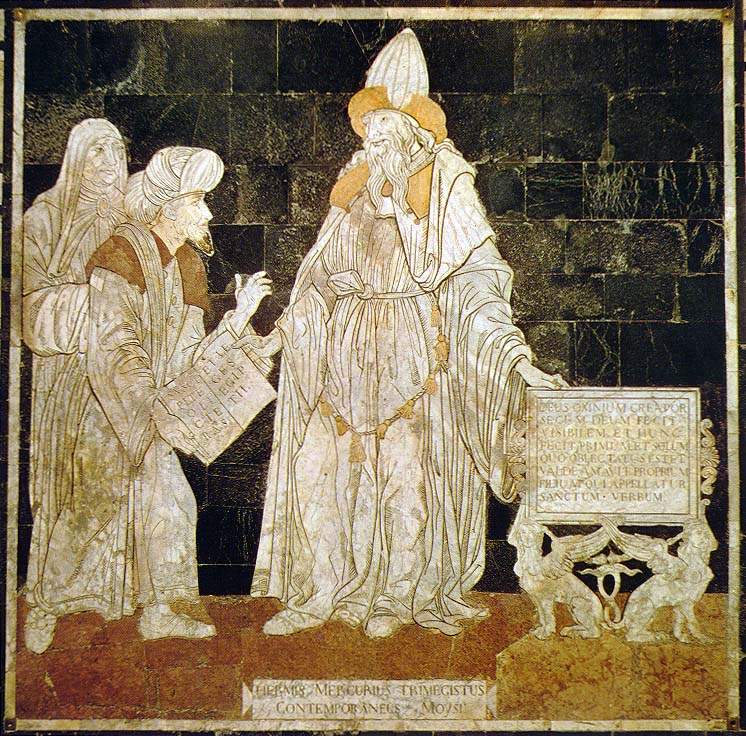
Hermeticism teachings center on a single claim, repeated in different words across two thousand years of transmission: the universe is fundamentally mental, its patterns repeat across every scale of existence, and a disciplined mind can learn to work with those patterns instead of being pushed around by them. Everything else attributed to the tradition — its talk of correspondence, vibration, polarity, rhythm, and cause and effect — is an elaboration of that one claim, applied to different corners of experience. What makes the subject harder to pin down than it should be is that "hermeticism" was never delivered as a finished curriculum. It arrived as fragments, restated by different teachers in different centuries, and the fragments do not always agree with each other on the details.
What the Core Hermeticism Teachings Actually Say
The written record begins with the Corpus Hermeticum, a set of Greek dialogues compiled sometime in the first centuries after Christ, though the ideas inside them are older. Its opening text, known as the Poimandres, stages a vision: a divine intelligence appears to the narrator and explains how mind gave rise to the cosmos, how a portion of that mind descended into matter as the human soul, and how the soul can ascend again by shedding, level by level, the traits that bind it to the physical world. That ascent narrative is the oldest hermetic teaching we can document, and it already contains the tradition's central move — treating the physical world as a derivative of mind rather than the other way around.
Centuries later, a slim English volume titled The Kybalion (1908) restated the same claim in plainer terms, organizing it into seven axioms: Mentalism, Correspondence, Vibration, Polarity, Rhythm, Cause and Effect, and Gender. The book put it directly:
"As above, so below; as below, so above." — The Kybalion
That single line is doing more work than it looks like it's doing. It is not a decoration; it is the mechanism by which hermeticism teachings claim to be useful at all. If the same pattern governs a solar system, a chemical reaction, and a human mind, then studying any one of them honestly teaches something true about the other two. That is the whole justification for treating astrology, alchemy, and introspection as branches of one discipline rather than three unrelated pursuits.
How the Hermeticism Teachings Were First Passed Down
The tradition's own account of its transmission is almost as important as its content. The Hermetic Philosophy text collected in the Corpus Hermeticum tradition insists that the teachings were carried "from master to student, from initiate to hierophant, mouth to ear," almost never committed fully to paper, and when they were written down at all, their meaning was deliberately clouded in the language of alchemy and astrology so that only someone already holding the key could read them plainly. The stated reason was not secrecy for its own sake, but timing: a teaching handed to someone unready to receive it was considered wasted, or worse, dangerous. The tradition summarized this with a phrase borrowed by early Christian writers as well — "milk for the babes, meat for the strong."
This is why hermeticism teachings so rarely appear as a tidy textbook, ancient or modern. What survives is closer to a compressed index: axioms, maxims, and short commandments that meant little to an outsider but opened up considerably once a teacher had walked a student through the reasoning behind them. The Kybalion itself is explicit that it is offering "explanations and illustrations" of maxims whose original wording was left deliberately obscure — a commentary on a older oral core, not a replacement for it.
That same instinct — protecting a teaching from students not ready to use it well — echoes far outside the hermetic corpus. Scripture's own wisdom literature shows a comparable caution about hard-won conclusions: the weary, circling arguments attributed to Ecclesiastes Solomon read very differently once a reader has lived long enough to test them, which is close to the gap in readiness the hermetic teachers were managing by withholding their own maxims from beginners.
The Three-Fold Wisdom Behind the Hermeticism Teachings
Older sources describe Hermes Trismegistus's legacy as threefold: he is credited as the founder of astrology, the discoverer of alchemy, and — in a category modern readers often overlook — a teacher of what antiquity called theurgy, direct communication with the divine through disciplined inner work. The "Trismegistus" title itself, meaning "the thrice-great," is usually read as an honorific for this three-part mastery rather than a literal count of anything.
Of the three, alchemy is the one most often misunderstood by modern readers, who assume it was chiefly about metals. Hermetic sources treat the transmutation of lead into gold as an allegory layered over the real subject: the transmutation of one mental or spiritual state into another. The philosopher's stone, in this reading, is not a substance a person manufactures but a capacity a person develops — the ability to change base states of mind into refined ones by applying the very laws the tradition claims govern everything else. Astrology, in the same threefold scheme, was less a predictive art than a study of correspondence: mapping how the visible motions of the heavens mirror invisible motions within the self.
Lineages that draw on this same wisdom often trace their authority through unusually long chains of custody, some claiming continuity stretching back not just to Hermes but through named historical figures such as King Solomon, whose reputation for discernment eventually outgrew the man himself — a drift traced in detail by what the phrase "wisdom of Solomon" actually means today. The Hellenistic world that produced that phrase's biblical namesake is, in fact, the same milieu in which the earliest hermetic dialogues were being written, in the same city, by writers working through the same tension between Greek philosophy and older Near Eastern wisdom.
Hermeticism Teachings Inside the Mystery School Tradition Today
Modern mystery schools that carry hermetic material forward have not abandoned the old preference for direct transmission, even though the source texts have been in print for over a century now and are a search away for anyone curious. The reasoning given is consistent with the ancient one: reading a maxim and receiving it from a teacher who has lived by it are treated as two different events, producing two different depths of understanding. A student can memorize "as above, so below" in an afternoon; applying it honestly to one's own patterns of thought is described as the work of years, done under guidance rather than alone.
What actually gets taught, in practice, tends to fall into three connected areas: a philosophical foundation (the axioms and the claim that mind precedes matter), a set of interpretive tools (correspondence, polarity, rhythm, applied to a student's own life rather than left abstract), and an ethical frame — the idea that mastering these laws obligates a person to use that mastery responsibly, since the same capacity that heals can just as easily harm. None of this requires supernatural assent to be useful; it can be engaged as a rigorous way of examining one's own mental habits, which is largely how contemporary teachers present it to newcomers before any deeper commitment is asked of them.
Read this way, hermeticism teachings are less a body of secret facts than a discipline of attention — a claim that the world rewards careful, patient study of pattern, and a centuries-old insistence that such study is best done in the company of someone who has already made the attempt.
Walk the Path of the Initiate
These teachings come alive in The Initiated — Paul Schulz's introduction to the living mystery school tradition.
Get the BookFrequently Asked Questions
What are the core hermeticism teachings?
The core hermeticism teachings hold that the universe is fundamentally mental, that patterns repeat across every scale of existence, and that a disciplined mind can align itself with these patterns rather than being ruled by circumstance. Everything else in the tradition — its language of correspondence, vibration, polarity, rhythm, and cause and effect — expands on that single claim.
Where do hermeticism teachings actually come from?
Hermeticism teachings are attributed to Hermes Trismegistus, a legendary Egyptian sage identified with the god Thoth. The surviving written record is the Corpus Hermeticum, a set of Greek-language dialogues compiled in late antiquity, later supplemented by condensed maxims such as those collected in The Kybalion (1908).
How were hermeticism teachings originally transmitted?
Largely by mouth, from master to disciple, rather than by book. The tradition itself explains this choice as deliberate: teachings given before a student is ready are said to be wasted, or worse, misused — the old formula was "milk for the babes, meat for the strong."
Is hermeticism a religion or a philosophy?
Neither cleanly. Hermeticism teachings were designed to sit beneath religious doctrine rather than replace it, which is why the tradition surfaces inside Christian, Jewish, and Islamic esoteric currents alike without ever becoming a creed of its own.
Do modern mystery schools still teach hermeticism the same way?
The content has been written down and published for over a century, but the mystery school tradition still transmits it chiefly through direct teacher-to-student instruction and initiation, holding that the teachings land differently when given in person than when merely read.