Jesus and Solomon: What the New Testament Actually Does With the Comparison
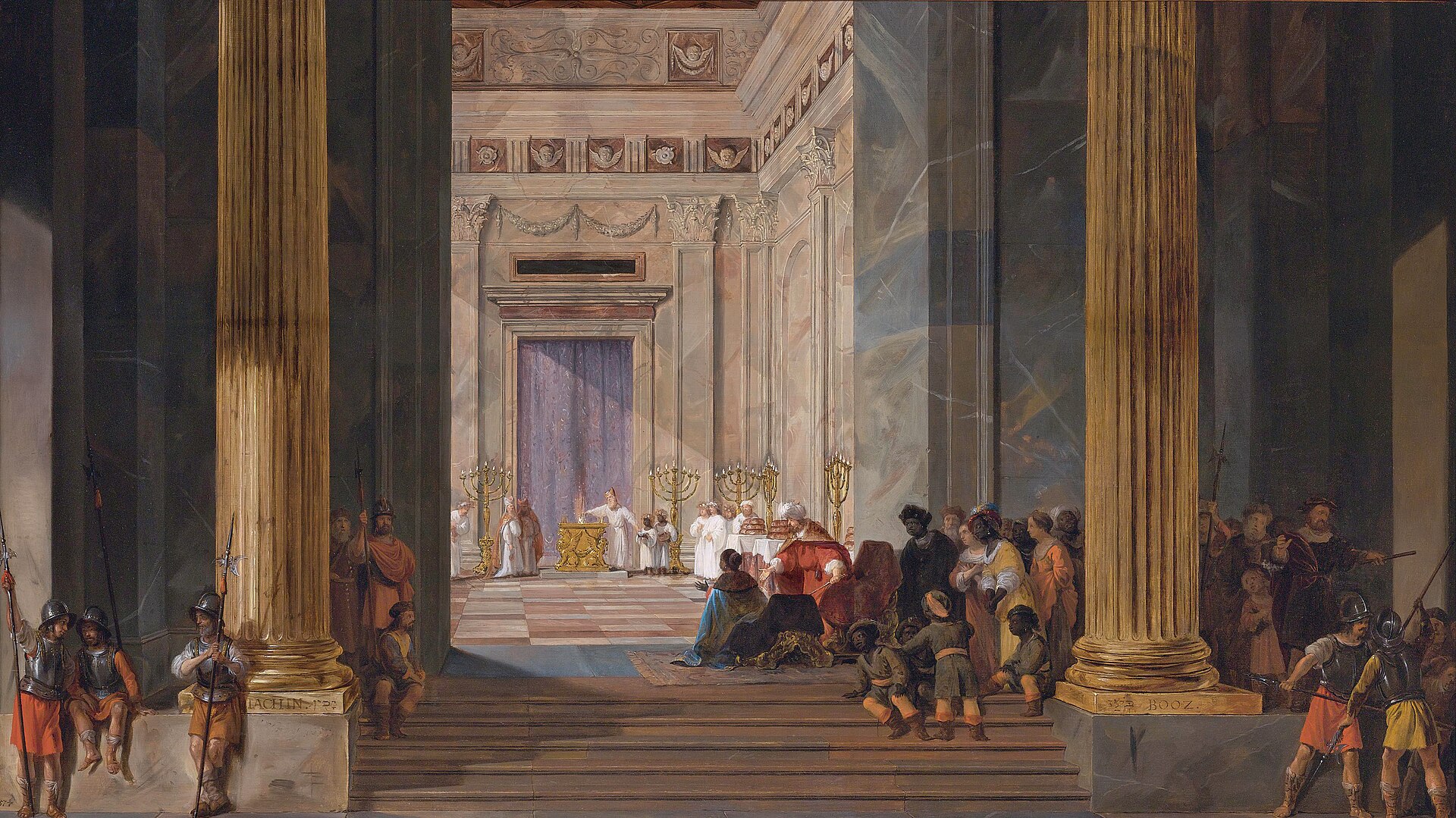
Jesus and Solomon are connected in the New Testament in three specific, traceable ways: a genealogy that runs through him in one gospel, two sayings in which Jesus measures his own authority directly against Solomon's reputation, and a Temple Solomon built that Jesus later confronted in his own words and actions. None of these connections is incidental. Each appears in scripture by name, and together they form the fullest comparison the Bible draws between its wisest king and the figure Christian tradition came to read as greater than him.
The Genealogy That Runs Through Solomon, and the One That Doesn't
Matthew opens his gospel with a king list: Abraham to David, David to Solomon, Solomon down through the kings of Judah, to Joseph, husband of Mary. It is a genealogy of the throne itself, naming four women along the way — Tamar, Rahab, Ruth, and Bathsheba, listed only as "her that had been the wife of Urias" — each remembered for an irregular entry into the royal line rather than an ordinary marriage. Luke's genealogy, read backward from Jesus to Adam, also passes through David, but not through Solomon. It runs instead through a son named Nathan, listed two verses after David's own name in 1 Chronicles 3:5 as Solomon's full brother, sharing both parents with him.
Scholars have argued for centuries over why the two accounts diverge — whether Luke records Mary's line rather than Joseph's, or whether both evangelists were working from genealogical traditions already in some disagreement by the first century. What is not in dispute is the shape of the disagreement itself: both gospels insist Jesus descends from David, and neither is willing to simply repeat the other's path to get there. One chooses the throne's own line, carried through Solomon and every king who followed him. The other reaches past the throne entirely, through a brother who never ruled at all.
"A Greater Than Solomon Is Here"
Twice in the Gospels, Jesus invokes Solomon by name, and both times the comparison is deliberate. In the Sermon on the Mount, he points to a wildflower: "even Solomon in all his glory was not arrayed like one of these" (Matthew 6:29), using the king's famous opulence as the very thing a lily outdoes without effort. Later, responding to a crowd demanding a sign, he reaches for Solomon again, this time for authority rather than luxury. He recalls the Queen of the South, who "came from the uttermost parts of the earth to hear the wisdom of Solomon," then adds: "a greater than Solomon is here" (Matthew 12:42).
Neither line works as rhetoric unless the audience already holds Solomon in the highest possible regard. Jesus is not introducing Solomon to people who need convincing of his greatness; he is borrowing an assumption everyone in the room already shares and placing his own claim directly on top of it. A thousand years after Solomon's reign, his name alone was still shorthand for the limits of human splendor and wisdom — which is exactly why it was useful to a teacher trying to describe something he insisted stood beyond those limits.
Two Houses: The Temple Solomon Built and the Temple Jesus Named
Solomon's defining act, across 1 Kings 5 through 8, is construction: cedar from Lebanon, a sanctuary overlaid in gold, a dedication prayer asking whether any house built by hands could actually contain the God it was built for. That building, rebuilt and expanded under Herod by the first century, was still standing when Jesus taught — and its colonnade was apparently well known enough that the earliest church kept meeting inside part of it, an area Acts 3:11 and 5:12 call Solomon's Porch, as if the structure's original builder still mattered to how people located themselves within it.
Jesus engages the same building twice, in sharply different registers. He clears merchants from its courts, citing the prophets against turning a house of prayer into a marketplace (Mark 11:15-17) — a direct, physical claim on what Solomon's house was for. And when questioned about his authority to do so, he answers with something closer to a riddle than a defense: "destroy this temple, and in three days I will raise it up." John's gospel is careful to add that "he spake of the temple of his body" (John 2:19-21), deliberately reusing Solomon's building language — a temple, raised — for something no mason, however skilled, could construct. Where Solomon took seven years and an empire's resources to build a house for God, the claim attributed to Jesus measures its own house in three days and makes it out of something that cannot be quarried.
One Promise, Two Kings: The "Son of David" Title
Behind both the genealogy and the Temple sits a single older promise. In 2 Samuel 7, the prophet Nathan tells David that his throne will be established forever and that his son, not David himself, will build the house for God's name. The promise lands on Solomon almost immediately — he is the son who builds the Temple, and 1 Chronicles 22 has David naming him specifically for that task. But the promise's own language, an "everlasting" throne, outlasted Solomon's own dynasty by centuries, and first-century Jewish expectation of a coming "son of David" who would restore righteous rule had become, by the Gospels' own telling, a fixed and widely shared hope.
That title lands on Jesus again and again in the Gospels — blind men calling out to him by it (Matthew 9:27, 20:30-31), crowds chanting it as he enters Jerusalem (Matthew 21:9). Solomon is where the promise to David first visibly worked, a son inheriting an actual throne. The Gospel writers present Jesus as where the same promise, after resting unfulfilled for a thousand years, comes to what they frame as its final rest — not a rejection of what happened to Solomon, but a claim that the story Nathan's oracle started was never only about him.
How the Mystery Tradition Reads Jesus and Solomon Together
Christian doctrine reads "a greater than Solomon is here" as a statement of rank — one figure exceeding another on the same scale of wisdom and authority. The initiatory tradition Paul Schulz teaches reads the relationship differently: not as rank, but as succession. The tradition traces its own transmitted teaching back more than three thousand years in written record to King Solomon, named as the lineage's founder — the first in a sequence of teachers through whom the same current of instruction is said to pass, rather than a rival Jesus must be measured against and surpass. Jesus appears later in that same sequence, remembered within it as a master teacher of love and transformation, carrying forward rather than competing with what Solomon first opened.
That reading rests on a wider principle the Hermetic tradition states directly: "that which is below is like that which is above," examined at greater length in the essay on what the Emerald Tablet actually says. A Temple built once in cedar and gold, and a second one the Gospels say could be raised in three days out of nothing a mason could touch, read as two expressions of one underlying pattern rather than as a correction of the first by the second. The three days themselves echo a shape the tradition recognizes elsewhere too — a complete unmaking that precedes, rather than cancels, what comes after it, the same structure traced in the essay on what's actually happening when you say "a dark night of my soul". Read this way, Jesus and Solomon are not a contest the New Testament settles in one figure's favor. They are two points on a single line the tradition insists never actually broke.
Walk the Path of the Initiate
These teachings come alive in The Initiated — Paul Schulz's introduction to the living mystery school tradition.
Get the BookFrequently Asked Questions
Was Jesus a descendant of Solomon?
According to Matthew's genealogy (Matthew 1:1-17), yes: the line runs from David through Solomon and down the throne of Judah's kings to Joseph. Luke's genealogy (Luke 3:23-31) traces a different line, through Solomon's brother Nathan instead, so the two gospels do not agree on which son of David the ancestry runs through — only that it runs through David himself.
What does Jesus mean by "a greater than Solomon is here"?
In Matthew 12:42, Jesus answers a crowd demanding a sign by recalling how the Queen of the South traveled a great distance just to hear Solomon's wisdom, then says someone greater than Solomon now stands in front of them. The claim only carries force because Solomon's reputation for wisdom was still common knowledge a thousand years after his reign.
Did Jesus engage directly with the Temple Solomon built?
Yes, in two ways. He cleared merchants from its courts (Mark 11:15-17), and in John 2:19-21 he told questioners to "destroy this temple" and he would raise it in three days, a statement the gospel explains referred to his own body rather than Solomon's stone structure. The earliest church later kept teaching inside the same complex, in an area Acts 3:11 and 5:12 still call Solomon's Porch.
Is Solomon considered a type of Christ in Christian tradition?
Yes. Christian typology has long read Solomon as a forerunner of Christ: a son of David, a king whose reign meant peace, a builder of God's house, and a figure whose wisdom drew visitors from distant nations. Jesus's own "greater than Solomon" saying assumes this reading was already in place.
How does the mystery school tradition relate Jesus to Solomon?
Not as rivals but as successive initiates in one continuous lineage. The tradition Paul Schulz teaches traces its transmitted teaching back more than three thousand years to Solomon as its founder, with Jesus appearing later in the same sequence as a teacher of transformation rather than a competing claim to the same throne.