Kingdom of Solomon: How Israel's Empire Was Organized, and Why It Broke
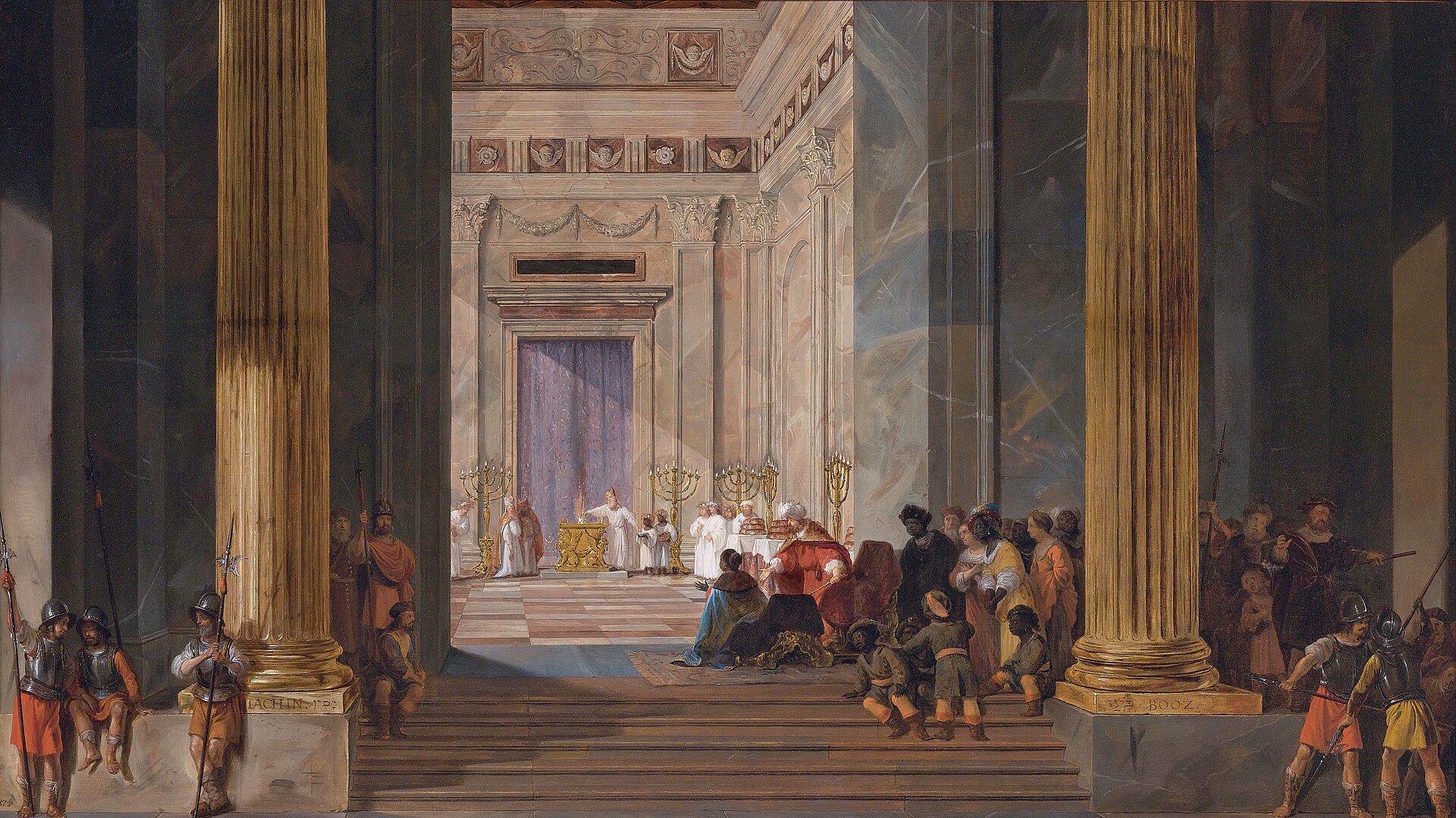
The kingdom of Solomon, according to 1 Kings 4:21, stretched "from the river unto the land of the Philistines, and unto the border of Egypt" — a sphere running from the Euphrates in the north to Egypt's frontier in the south, with the peoples inside it bringing tribute and serving Solomon "all the days of his life." That is the biblical claim in one sentence. What makes the kingdom worth studying closely is not just its size, but how it was actually run: a centralized administration built to override old tribal loyalties, a peacetime economy funded by tribute and trade, and a structure so tightly bound to one king's authority that it did not survive his death by more than a single bad decision from his son.
Most people who search for the kingdom of Solomon already know the highlights — the Temple, the wealth, the visit from the Queen of Sheba. Fewer know how it was organized: the twelve districts that fed the royal court, the chariot cities that held the trade routes, and the fault lines already visible before Solomon's reign even ended.
The Kingdom of Solomon's Borders: From the Euphrates to Egypt
1 Kings 4:24 sharpens the claim of verse 21: Solomon "had dominion over all the region on this side the river, from Tiphsah even to Azzah, over all the kings on this side the river: and he had peace on all sides round about him." Tiphsah sat on the Euphrates in the north; Azzah is Gaza, near Egypt's border. Read together, the two verses describe a hegemony running the length of the Levant — not a kingdom Solomon conquered by war, since scripture credits David's campaigns with subduing most of these peoples a generation earlier, but one Solomon inherited and held through tribute, marriage alliance, and a peace the text calls out as remarkable for its length.
Scholars read this description differently. Some treat it as a fairly literal record of a genuine regional hegemony, pointing to the tenth-century political vacuum left by a weakened Egypt and a not-yet-risen Assyria — a gap David and Solomon's Israel was positioned to fill. Others read the verse as later theological idealization, describing the ideal reach of a righteous king rather than a precise territorial map. Both readings agree on the text's own claim about the kingdom's internal character: 1 Kings 4:25 says "Judah and Israel dwelt safely, every man under his vine and under his fig tree... all the days of Solomon" — an image of settled prosperity that became, centuries later, a Hebrew idiom for peace itself.
Twelve Districts, One Administration: How the Kingdom of Solomon Was Governed
The clearest window into how the kingdom of Solomon functioned is 1 Kings 4:7-19, a list of twelve officers, each assigned a district and responsible for provisioning the royal household with food for one month of the year. The chapter names the officers by their fathers' names and lists their regions in careful, almost bureaucratic detail — an administrative record unusual for a document this old, one many historians take as evidence of an actual royal archive behind the text.
What stands out about the twelve districts is what they deliberately are not: they do not map cleanly onto Israel's twelve traditional tribal territories. Several districts cut across old tribal lines or combine pieces of more than one tribe under a single officer. Historians generally read this as intentional statecraft — pulling administrative loyalty away from tribal identity and toward the crown in Jerusalem, the same logic behind centralizing worship at one Temple rather than scattered regional shrines. It is the kind of structural choice a kingdom makes when trying to become a state rather than remain a confederation of tribes, and it held for Solomon's own reign.
"Judah and Israel were many, as the sand which is by the sea in multitude, eating and drinking, and making merry." — 1 Kings 4:20, KJV
The same chapter records the daily provisions this administration produced for the royal table: thirty measures of fine flour, sixty of meal, ten fat oxen, twenty oxen out of the pastures, a hundred sheep, plus harts, roebucks, fallow deer, and fattened fowl (1 Kings 4:22-23). Whatever portion of this is precise record and what portion is rhetorical flourish, the passage does real work: it tells the reader the kingdom could sustain a royal court on this scale continuously, month after month, district after district, without visible strain — the clearest proof, in the text's own logic, that the administration functioned.
Fortresses, Chariots, and the Kingdom's Trade Network
1 Kings 9:15-19 describes the building projects that gave the kingdom its shape beyond Jerusalem: Solomon rebuilt Millo, fortified Hazor, Megiddo, and Gezer, and built store cities along with "cities for his chariots, and cities for his horsemen." Archaeologists debate how much of the surviving fortification at these sites dates precisely to Solomon's reign, but the text's logic is consistent — a kingdom whose wealth depended on trade routes needed garrisoned cities to protect them, and Megiddo sat directly on the route linking Egypt to Mesopotamia.
1 Kings 10:26-29 adds that Solomon accumulated fourteen hundred chariots and twelve thousand horsemen, stationed partly in Jerusalem and partly across the chariot cities, and ran a trading operation bringing horses from Egypt and Kue through royal merchants. Combined with the maritime trade in 1 Kings 9:26-28 — a fleet built at Ezion-geber that sailed to Ophir and returned with gold — the picture is of a kingdom whose power rested as much on commerce as on territory. That wealth is covered at length in King Solomon Treasure: What the Bible Actually Records, and What Legend Added, which traces the 666 talents of gold 1 Kings 10:14 says arrived annually.
The Cracks Already Showing Before the Kingdom Split
The text does not present the kingdom of Solomon as flawless even at its height. 1 Kings 11 names three adversaries who troubled his later reign: Hadad the Edomite, who returned from exile in Egypt to trouble Solomon from the south; Rezon, who seized Damascus and became "an adversary to Israel all the days of Solomon" in the north; and Jeroboam, an official Solomon had placed "over all the charge of the house of Joseph," who was told by the prophet Ahijah that ten tribes would be torn from Solomon's house and given to him. The same chapter names the cause: Solomon's foreign wives had turned his heart toward other gods, and for that the kingdom would be divided — though not in his lifetime, "for David thy father's sake," and not entirely, since one tribe would be preserved for his line.
That preserved kingdom, and the son who lost the rest of it within months of his coronation, is its own story — told in full in Solomon Son Rehoboam: The Heir Who Split the Kingdom His Father Built. What matters here is the shape of the warning: the same administrative machinery that let Solomon govern from the Euphrates to Egypt — heavy taxation, conscripted labor, centralized control overriding tribal loyalty — is what the northern tribes cited when they asked Rehoboam for relief at Shechem. The kingdom's strength and its fracture point were, in the text's own account, the same structure seen at two different moments.
What the Mystery Tradition Makes of a Kingdom Built on Order
The lineage I was initiated into traces its written record more than three thousand years back to King Solomon, and it reads the kingdom he built less as a political case study than as an illustration of a wider principle: wisdom rightly received expresses itself as order — in a household, a temple, a kingdom's own administration — and order sustained by wisdom outlasts order sustained by force alone. Twelve districts feeding one royal table, garrison cities holding trade routes open, a fleet reaching distant Ophir and returning: initiates are taught to see in this a working model of the same law the tradition applies inwardly, the disciplined arrangement of scattered parts into a coherent whole. The kingdom's undoing came only when that discipline slipped. The order was never the failure. What gives way, the tradition holds, is always the wisdom meant to sustain it.
Walk the Path of the Initiate
These teachings come alive in The Initiated — Paul Schulz's introduction to the living mystery school tradition.
Get the BookFrequently Asked Questions
What was the kingdom of Solomon?
The kingdom of Solomon was the united monarchy of Israel during the reign of David's son and successor, roughly 970 to 930 BCE. Scripture describes it as stretching from the Euphrates River to the border of Egypt, governed from Jerusalem through twelve rotating administrative districts, and known for its Temple, its wealth, and the peace that held for most of Solomon's forty-year reign.
How big was the kingdom of Solomon?
1 Kings 4:21 says Solomon reigned over all the kingdoms from the Euphrates River to the land of the Philistines and the border of Egypt, with those territories paying tribute and serving him. That description covers a sphere of influence far larger than Israel's core tribal territory, though scholars debate how much of it was direct rule versus vassal alliance and tribute.
How did Solomon govern such a large kingdom?
1 Kings 4:7-19 lists twelve officers, each responsible for provisioning the royal household for one month of the year from his assigned district. The districts largely ignored the old tribal boundaries, which historians read as a deliberate move to centralize loyalty around the crown in Jerusalem rather than around tribal identity.
What happened to the kingdom of Solomon after he died?
The kingdom split within months of Solomon's death. His son Rehoboam refused to lighten the labor and taxation that had funded Solomon's building projects, and ten of the twelve tribes broke away under Jeroboam to form the northern kingdom of Israel, leaving Rehoboam only Judah and Benjamin in the south.
Was the kingdom of Solomon really an empire?
By the definition of direct territorial rule, probably not in the way Assyria or Egypt were empires. Most historians read Solomon's kingdom as a smaller core state at the center of a wider network of tribute-paying vassals and trade partners, held together by marriage alliances, fortified garrison cities, and personal loyalty to the king rather than permanent occupation.