Mystery School: What It Is, Its History, and How the Living Tradition Works
A mystery school is an initiatory tradition that transmits sacred knowledge through direct experience — ritual, ordeal, symbol, guided inner work — rather than through public teaching alone. The word "mystery" comes from the Greek mysterion, meaning something into which one is initiated, not something merely unexplained. For roughly two thousand years these schools operated across the ancient Mediterranean, training statesmen, philosophers, and priests in disciplines they were forbidden to describe to the uninitiated. Most of them are gone. A few, the tradition holds, are not.
This essay traces what a mystery school actually was, why the ancient ones nearly vanished from history, and how the same initiatory current is said to survive — not as metaphor, but as a documented, functioning lineage that still opens its doors to seekers today.
What Made a School a "Mystery" School
Three features distinguished a mystery school from ordinary religious or philosophical instruction in antiquity.
First, admission required initiation — a formal rite of passage a candidate underwent once, marking an irreversible change in status. You were not born into the mysteries the way you were born into a civic religion; you crossed a threshold into them, usually after preparation.
Second, the core teaching was oral and experiential, not written. Sacred geometry, cosmology, the nature of the soul, and the technique of specific rites were held to lose their meaning if reduced to a text a stranger could pick up and read. What survives from the mysteries is almost entirely the testimony of outsiders and the occasional oblique reference from an initiate who skirted their oath of silence.
Third, secrecy was not incidental — it was structural. The Eleusinian Mysteries, celebrated near Athens for roughly two thousand years in honor of Demeter and Persephone, initiated tens of thousands of people including Plato, Cicero, and multiple Roman emperors, and yet no participant ever described in writing what happened inside the Telesterion, the great hall of initiation. Cicero called Eleusis the greatest gift Athens ever gave to human life, "not only a reason to live with joy, but to die with better hope" — and said essentially nothing about what he had seen. That silence held for two millennia, kept not by force but by the initiates' own conviction that the thing was not theirs to give away.
The Ancient Landscape of Initiation
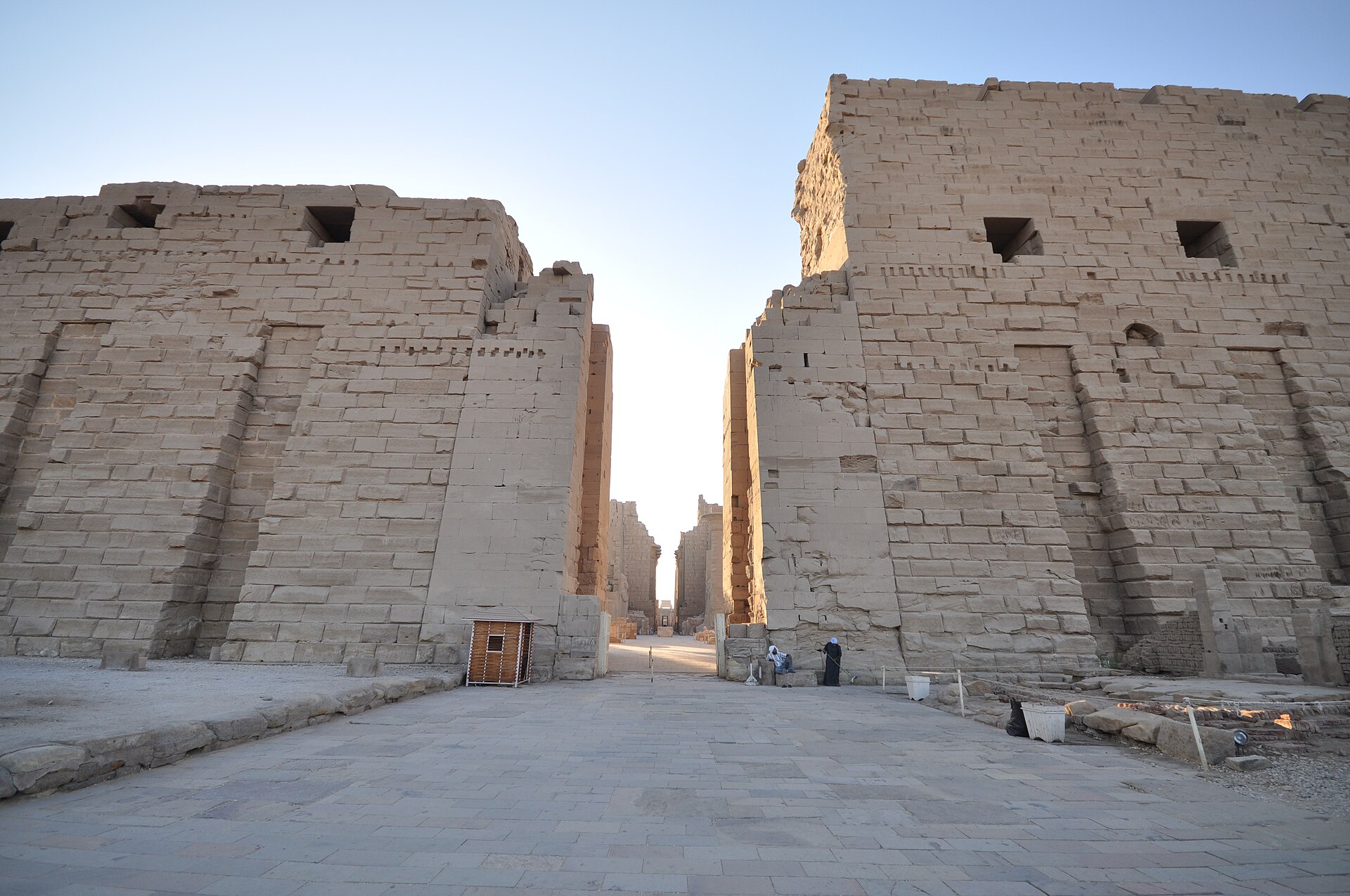
Eleusis was not alone. Egypt's temple complexes — Karnak among them, its great pylon gates still standing on the Nile — trained priesthoods in disciplines that Pythagoras, Plato, and later Hermetic writers all claimed as their source. Egyptian temple initiation is described, allegorically and at a remove, in texts as late as the Hermetica, the writings attributed to Hermes Trismegistus, the "thrice-great" figure the Egyptians identified with Thoth. Pythagoras founded his own initiatory brotherhood at Croton in southern Italy around 530 BCE, combining mathematics and a doctrine of the soul's transmigration with a probationary period and vows of silence that mirror the temple traditions he is said to have studied in Egypt. The Mithraic, Orphic, and Dionysian mysteries each held their own graded initiations across the Greco-Roman world.
What linked them was not doctrine — their cosmologies differed — but method. Each held that certain truths cannot be taught, only undergone.
Why the Ancient Schools Nearly Disappeared
The mysteries did not fade from neglect; they were dismantled. Theodosius I's edicts of the late fourth century CE banned pagan religious practice across the Roman Empire, and Eleusis, already damaged by Alaric's Visigothic raid in 396 CE, never reopened. Temple initiation in Egypt withered as Christianity became the state religion of the region it had governed for three thousand years. The content of the deepest initiations was never written down in the first place, so when the last initiates died without training successors, that content did not survive as a text to be rediscovered. It simply ended.
This is the wound at the center of most modern claims to mystery school lineage: most groups using the language of "ancient mysteries" today are reconstructions — sincere, sometimes valuable, but reconstructions nonetheless, not unbroken transmissions.
King Solomon and a Different Kind of Claim
The tradition I was initiated into makes a narrower and more specific claim than "we have revived the ancient wisdom." It holds that one line of initiation, tracing to King Solomon roughly three thousand years ago, was never broken — that it continued privately, initiate to initiate, through the very centuries when Eleusis fell silent and the Egyptian temples emptied, and that it remained hidden by design rather than by accident, since a lineage that depends on secrecy for its survival does not advertise itself in eras hostile to it.
Solomon's own tradition holds him as recipient of wisdom directly granted rather than merely accumulated — a builder of the Temple in Jerusalem and, in the mystery school reading, an initiator who founded a line of transmission that outlasted his kingdom. Whether one reads that claim as literal history or as the tradition's own foundational mythos, the practical fact is this: in 1997, after millennia of privacy, that lineage's most senior living initiate at the time, Gudni Gudnason, brought it into public view for the first time, founding what is now called the Modern Mystery School. Two other lineage holders, Dave Lanyon and Hideto Nakagome, now hold that responsibility alongside him, together with a Council of Twelve women initiates who guide the school's global direction. It is, by its own description, the only one of seven mystery schools it identifies as still functioning in the world today that has opened its doors to any sincere seeker, rather than restricting entry by birth, sect, or region.
I do not ask a reader to take that claim of unbroken lineage on faith any more than the tradition itself does. What I can say from the inside of it is this: the structure matches exactly what the ancient sources describe — a first initiation into adepthood opening the door to everything after it, progressive stages of training in healing and ritual work, an oral transmission the tradition insists must remain a living relationship rather than a text, and a governing hierarchy whose stated purpose is to protect the purity of what is passed down. That is not proof of an unbroken chain back to Solomon. It is, at minimum, proof that whatever this is, it was built by people who understood exactly what the ancient mysteries were doing.
What Initiation Is Actually For
It is worth being honest about what a mystery school offers and what it does not. It does not offer ease, and the tradition frames its central path, that of the Ritual Master, as a confrontation with one's own ego before it is a confrontation with anything external — a multi-year process, not a weekend fix. What initiates describe, consistently across very different eras and cosmologies, is not new information so much as a shift in the relationship between the self and the source of one's own life. The Delphic maxim Know Thyself remains the closest thing the entire mystery tradition has to a shared motto, ancient or modern. Every technique — sacred geometry, meditative discipline, ritual, the study of correspondence between the human and the cosmos through frameworks like Kabbalah's Tree of Life — exists in service of that single instruction.
This is also why the mystery schools have resisted comparison to religion in the ordinary sense. A religion generally asks for belief, offered from without. A mystery school asks for initiation, undergone from within, and holds — as the Kybalion put it centuries after Eleusis fell silent — that the lips of wisdom are closed except to the ears of understanding. That is a claim, testable only by the one who undergoes it, that some doors only open from the inside.
"We don't want you to believe what we tell you. We want you to put it to the test in your own life and see if it works for you."
That instruction, in one form or another, could have been spoken at Eleusis, at Croton, or in Solomon's court. It is the one constant across every mystery school named here, ancient and living alike: the insistence that the teaching be tested rather than accepted, and that the testing itself is the initiation.
Readers drawn to the architecture behind this — how the hermetic principles and the Kabbalistic Tree of Life function as working tools of that testing — may find Hermeticism and Kabbalah: Where the Two Traditions Converge a useful next essay. For the philosophical foundation the modern lineage still teaches from, see Kybalion: What the Book Actually Teaches and Why It Still Matters.
Walk the Path of the Initiate
These teachings come alive in The Initiated — Paul Schulz's introduction to the living mystery school tradition.
Get the BookFrequently Asked Questions
What is a mystery school in simple terms?
A mystery school is a tradition that teaches through direct initiatory experience instead of public doctrine. Candidates undergo structured rites said to transform consciousness rather than merely inform it, and the deeper teachings pass from initiate to initiate rather than being published for a general audience.
What is the difference between a mystery school and a religion?
A religion generally asks for belief and offers its teachings openly to anyone who will listen. A mystery school asks for initiation and holds that certain understanding can only be transmitted through direct experience, under the guidance of someone who has already walked the path. The two are not mutually exclusive.
Are there mystery schools that still exist today?
Most schools of antiquity — Eleusis, the temples of Egypt, the Pythagorean brotherhoods — closed centuries ago and left no continuous line of initiation. A small number of traditions claim an unbroken lineage reaching into the ancient world, and at least one, the Modern Mystery School tracing its lineage to King Solomon, operates publicly today and initiates seekers of any background.
Do you have to belong to a specific religion to join a mystery school?
No. Ancient candidates at Eleusis were required only to speak Greek and have clean hands; they kept whatever gods they already worshipped. The same openness holds in the surviving lineage today.
What actually happens during an initiation?
The specifics vary by tradition and are, by design, not published in advance. In broad terms, most initiatory rites combine instruction, symbolic ordeal or ritual, and a transmission the tradition holds to be energetic rather than merely informational, culminating in a change of status recognized by the community of initiates.