Solomon Spiritual Meaning: What the Wise King Symbolizes in the Mystery Tradition
Solomon spiritual meaning, read outside the history books, points to wisdom actually lived rather than merely possessed — a king remembered less for his crown than for one request he made before he ever used it. Offered anything he wanted in a dream at Gibeon, Solomon asked for an understanding heart instead of wealth, victory, or long life, and the whole of his reign is remembered as the working-out of that single choice. In the mystery school tradition, Solomon is read less as a distant Iron Age monarch than as a symbol: the human mind matured into sovereignty, wisdom not simply known but seated on a throne and made to govern an entire life, a temple, and — eventually — a fall.
The Request Behind Solomon Spiritual Meaning: An Understanding Heart, Not a Crown
The scene is set at Gibeon, where 1 Kings 3 records God asking the newly crowned Solomon what he wants above all else. His answer is notable mostly for what it leaves out: no gold, no long life, no victory over enemies. Instead, by the text's own words, he asks for "an understanding heart to judge thy people, that I may discern between good and bad." The request is granted, and granted with interest — the passage adds riches and honor besides, precisely because he did not ask for them first.
The mystery tradition treats that ordering as the real teaching, more than the wisdom that followed it. Solomon names his own disqualification before asking for the remedy — he says plainly that he is young and does not know how to go out or come in among a people he has been handed responsibility for. Initiates describe this as the actual doorway into wisdom: it opens to admitted need, not to confidence. A mind convinced it already understands has nowhere left to receive anything; a mind honest about its own limits has made the one opening wisdom is said to enter through.
Wisdom Enthroned: Reading the King as an Inner State
The Modern Mystery School's central decree, inherited from the older Hermetic tradition, is simply "Know Thyself" — the school teaches that to know yourself is to know others, to know the universe, and to know God by whichever name a person uses. Solomon's story, read against that decree, becomes less a chronicle of a foreign king and more a map of what happens when self-knowledge is actually granted and then has to be lived: a mind that once served only itself is handed a kingdom, a court, foreign envoys, and disputes between mothers over a single child, and is asked to govern all of it from that same inner understanding rather than from cleverness or force. The famous judgment at the heart of his reign — ordering a disputed infant divided in two to see which claimant would flinch — is remembered precisely because it shows wisdom applied under real pressure, not wisdom recited as doctrine.
Seen this way, "Solomon" stops functioning only as a proper name and starts functioning as a stage: the point at which insight is no longer private but has to govern something outside the self — a household, a decision, a kingdom of one's own daily life. The tradition asks every serious student to reach that same stage eventually, on a scale suited to an ordinary life rather than an ancient throne.
The Temple as the Other Half of Solomon Spiritual Meaning
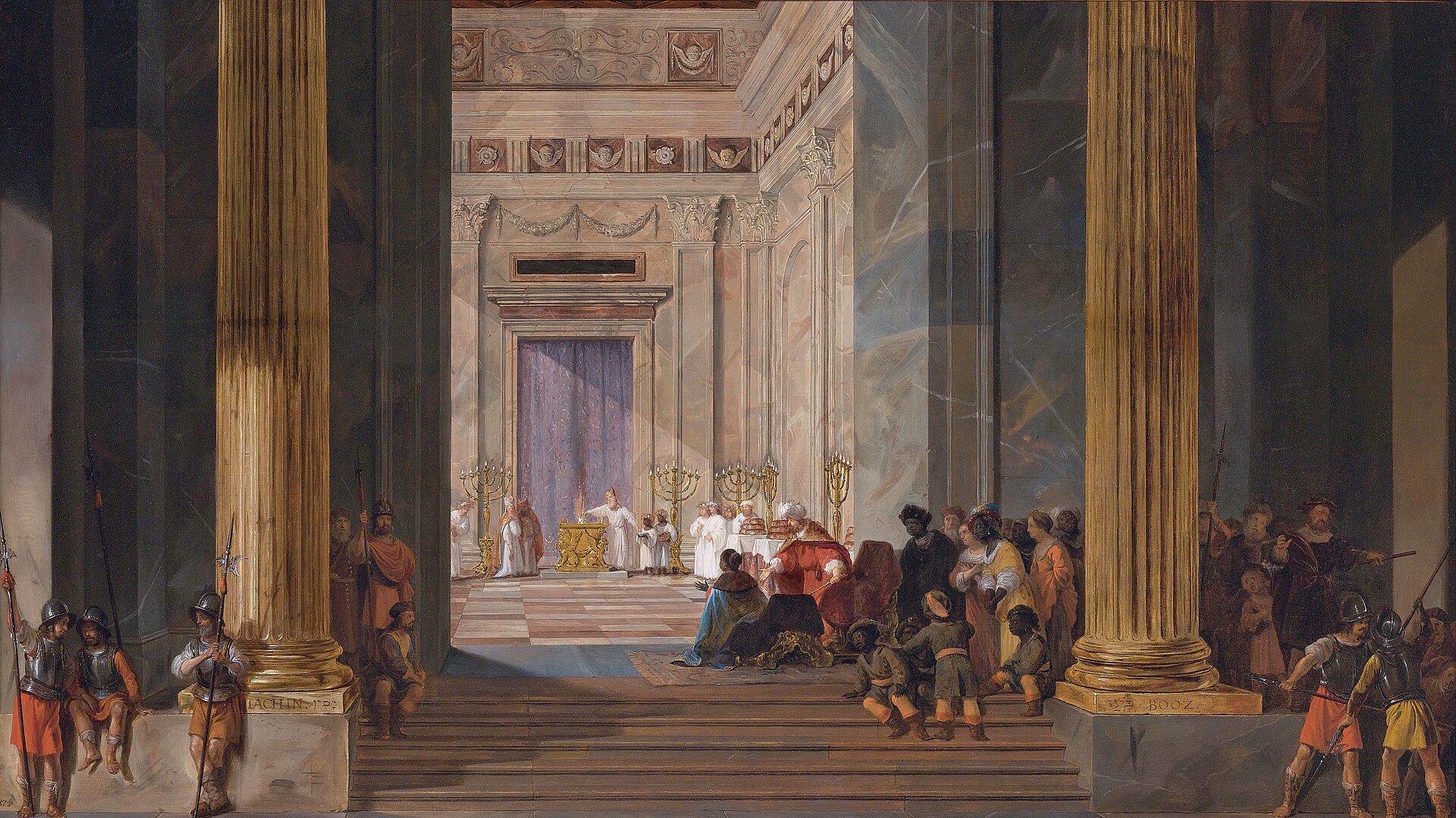
Solomon's other great labor was physical: seven years spent building a fixed house in Jerusalem for what scripture describes as the abiding presence of God, replacing a portable tent that had moved with Israel for generations. The mystery tradition reads that project as an outward picture of an inward requirement. Wisdom received in a single moment, at Gibeon or anywhere else, does not stay wisdom on its own — it needs a structure built to hold it, the way the Temple gave a wandering presence a fixed dwelling instead of a passing visit.
"Your greatest presentation of understanding the divine is in how you live, how you treat others, most especially how you treat yourself. Because the greatest temple that one can attend is inside the self." — Dave Lanyon, Modern Mystery School
Initiates take that instruction seriously as more than a metaphor: the discipline Solomon gave seven years of labor and cut stone to build outward, the tradition holds a student is asked to give comparable devotion to building inward — not once, but as an ongoing structure maintained across a lifetime, the same way a temple has to be kept, not merely dedicated and left.
Solomon as Lineage, Not Just Legend
Later legend turned Solomon into a magician-king who commanded spirits with a ring — a transformation the Hebrew tradition's own texts trace in detail, and one the mystery school treats as folklore layered over history rather than as instruction to reenact. What the Modern Mystery School claims instead is lineage, not magic: its written record reaches more than three thousand years back to King Salomon, its teaching of Kabbalah names him as a foundational source, and its Life Activation healing modality is described as tracing directly to his line, perfected across three millennia of transmission from teacher to student. In that framing, Solomon functions less as a distant historical curiosity and more as the named root of a still-living chain — the point the tradition points back to whenever it is asked where its authority actually comes from.
That claim of continuous transmission also explains why the tradition treats meditation and inner discipline as inseparable from Solomon's example rather than optional extras. Sustained meditation practice, built up across years rather than single sessions, is presented as the ordinary modern student's version of the same patient inner labor Solomon's Temple represents — the long, unglamorous maintenance of a structure built to hold wisdom rather than merely display it.
The Fall That Completes the Teaching
Scripture does not let Solomon's story end at the height of his wisdom. Later chapters describe his devotion eroding under the weight of his own success — wealth, foreign alliances, and, the text says plainly, a turning of his heart toward other gods in his old age. Ecclesiastes, traditionally read as his own late reflection, opens with a verdict startling for a man who had built and acquired more than almost anyone in scripture: "Vanity of vanities, all is vanity." Tradition reads that line not as despair but as an honest accounting — a king who had tested wisdom, pleasure, ambition, and accumulation in turn, and reported back on how little any of it satisfied once it was actually possessed.
The mystery school draws a specific lesson from that arc, distinct from treating it as simple tragedy: wisdom is not a fixed asset a person keeps once granted. It has to be renewed the way any living thing has to be tended, and even the wisest king remembered in scripture shows what happens when that tending stops. Read this way, Solomon's spiritual meaning is not only in the understanding heart he was given at the beginning of his reign, but in the full arc — gift, governance, building, and the quiet erosion that follows whenever inner devotion is allowed to lapse. The tradition holds that full arc, not the highlight alone, as the more honest and more useful teaching.
Walk the Path of the Initiate
These teachings come alive in The Initiated — Paul Schulz's introduction to the living mystery school tradition.
Get the BookFrequently Asked Questions
What is the spiritual meaning of Solomon in the Bible?
Scripture frames Solomon's meaning through a single choice: offered anything in a dream at Gibeon, he asked for an understanding heart rather than wealth or victory. The mystery tradition reads that request as the spiritual center of his whole story — wisdom sought before it is used, and asked for as a gift rather than seized as a possession.
Why did Solomon ask for wisdom instead of wealth?
The text itself gives Solomon's own reasoning: he was young, newly responsible for a whole people, and said he did not know how to go out or come in. The tradition reads that admission as the actual doorway to wisdom — it opens only to someone who has first admitted they do not yet have it, not to someone confident they already do.
What does Solomon's Temple symbolize spiritually?
Built over seven years as a fixed dwelling place for God's presence, the Temple is read in the mystery tradition as an outer picture of an inner requirement — that wisdom received has to be given a durable structure to live in, not left as a passing feeling. Initiates describe the same discipline applied inwardly as building a genuine dwelling for the divine within the self.
Does the mystery school tradition trace its lineage to Solomon?
Yes. The Modern Mystery School dates its written record more than 3,000 years back to King Salomon, treats him as a foundational figure for its teaching of Kabbalah, and names its Life Activation healing modality directly after his lineage. He functions there less as a distant historical king than as the named fountainhead of a still-transmitted teaching.
What does Solomon's fall from wisdom teach spiritually?
Later chapters describe Solomon's devotion eroding under the weight of his own excess, and Ecclesiastes, tradition holds, records his own reckoning with how much of what he built ultimately failed to satisfy him. Read spiritually, the fall teaches that wisdom is not a possession that stays secured once granted — it has to be tended, or it quietly drains away even from the wisest king remembered in scripture.