Alchemy and Hermeticism: How the Two Traditions Are Actually Related
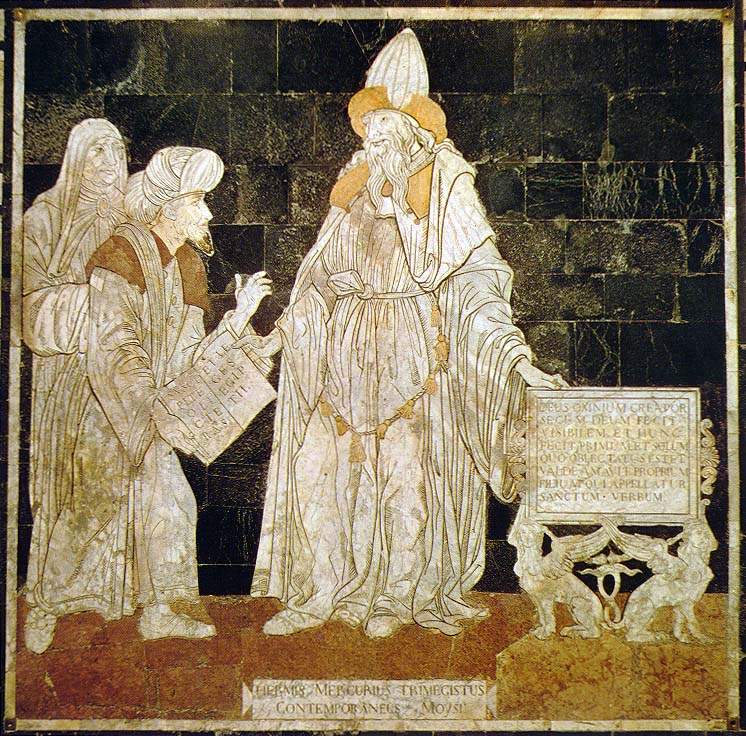
Alchemy and hermeticism are, historically, one tradition wearing two faces: hermeticism is the philosophy — the claim that a single set of laws governs mind, spirit, and matter alike — and alchemy is that philosophy put to work, first on metals in a furnace and later, more consequentially, on the self. Both trace their legendary authorship to the same figure, Hermes Trismegistus, and both rest on the same founding axiom, that what happens above happens below. Separate them and each becomes harder to explain; read them together and the strange vocabulary of both — as above so below, the philosopher's stone, the Great Work — starts to describe one coherent project rather than two unrelated curiosities.
Most people encounter the two traditions in reverse order from how they actually developed. Popular culture arrived at alchemy first, through Newton's secret manuscripts or a fictional stone that grants immortality, and at hermeticism second, if at all, usually through a paperback titled The Kybalion. The historical relationship runs the other way: hermetic cosmology came first, and alchemy is one of the disciplines it produced.
The Common Root: Hermes Trismegistus and the Emerald Tablet
Every strand of both traditions leads back to Hermes Trismegistus — "Hermes the Thrice-Great" — a legendary fusion of the Greek god Hermes and the Egyptian Thoth, credited by later writers as the author of the entire hermetic and alchemical corpus. No historian believes a single person wrote all of it; the texts bearing his name were produced by many hands across Greco-Roman Egypt, then expanded for centuries afterward. But the attribution itself is telling: whoever assembled this literature wanted alchemy and hermetic philosophy read as a single inheritance from one source, not two separate bodies of knowledge that happened to share a name.
The clearest evidence is the Emerald Tablet, alchemy's most quoted document and hermeticism's founding statement in the same short text. Its central line — "that which is below is like that which is above" — is pure hermetic cosmology, yet the tablet circulated for over a thousand years almost exclusively among alchemists, who treated it as instruction for their furnace work rather than abstract metaphysics. The line that alchemists actually built laboratories around is the same line hermetic philosophers built entire cosmologies around. That is not coincidence; it is the same idea serving two audiences.
Three Arts, One Root: Where Alchemy Fits Among the Hermetic Sciences
Medieval and Renaissance writers organized the hermetic inheritance into three practical arts, and alchemy was only one of the three. Astrology mapped the correspondence between celestial motion and earthly events. Theurgy, the more contested and rarely practiced third art, concerned direct communion with the divine through the higher soul rather than through matter. Alchemy took the middle position: it applied hermetic law to the physical world, working directly on substances to demonstrate — or so its practitioners held — that matter itself could be guided toward its own perfection, exactly as a soul could be guided toward wisdom.
Because all three arts drew on identical premises, a working alchemist in 1600 was rarely a specialist in only one. Paracelsus practiced medicine, astrology, and alchemy as a single discipline. This is why alchemy and hermeticism are so often named together rather than treated as adjoining fields: contemporaries did not experience them as adjoining. They experienced them as one worldview with several tools.
Two Kinds of Alchemy: The Laboratory and the Soul
Historians of alchemy generally distinguish two readings of the same body of texts, and both readings run through hermetic literature simultaneously rather than in separate books. Exoteric alchemy is the one most people picture: physical experiments with lead, mercury, and sulfur, conducted by figures like Nicolas Flamel and Michael Sendivogius, aimed at producing the Philosopher's Stone — a substance the tradition held could perfect base metal into gold and, in some accounts, extend human life. Whether any historical alchemist actually produced such a stone is not something the historical record settles; what the record does settle is that they believed the pursuit was rational, because a hermetic universe is one where matter, like mind, can be refined toward its own higher state.
Esoteric or spiritual alchemy reads the identical vocabulary — lead, mercury, sulfur, gold — as a description of inner transformation rather than metallurgy. In this reading, lead is not a metal but the unrefined, reactive self: habit, fear, unexamined appetite. Gold is not bullion but the self stripped of what does not serve it, restored to a state the tradition regards as its true nature rather than an addition to it. The alchemist's furnace becomes a metaphor for the conditions — discipline, heat, pressure, time — under which that inner refinement actually happens. Carl Jung later built an entire psychology on this second reading, arguing that the alchemists were unconsciously describing the process of individuation while believing they were describing chemistry.
The Great Work: What the Classical Stages Actually Describe
Alchemical texts organize the whole undertaking, physical or spiritual, into a sequence known as the Great Work, traditionally divided into color-coded stages: a blackening, a whitening, a yellowing, and a reddening, each marking a distinct phase of the material — or the person — under transformation. The blackening stage is associated with breakdown: old structure dissolves before anything new can form. The stages that follow describe purification, integration, and finally the stable, "fixed" state the tradition regards as complete. None of this sequence functions as instructions for a reader to carry out; it functioned, and still functions in the tradition, as a description of a process that unfolds under proper guidance and genuine transmission, not as a recipe a reader assembles alone from a page.
What makes this sequence worth understanding rather than dismissing as antique chemistry is how precisely it maps onto hermetic principle. The blackening stage is rhythm and cause and effect working together — nothing purifies without first being disturbed. The final, fixed stage is correspondence completed — the inner state now matches, rather than resists, the higher pattern it was always meant to reflect. Alchemy did not borrow hermetic principle loosely; it dramatized it, stage by stage.
Alchemy and Hermeticism in the Mystery School Tradition Today
Within the tradition Paul Schulz teaches, alchemy is understood less as a historical curiosity and more as a name for work that is still ongoing. The Modern Mystery School describes alchemy as the accelerated, conscious version of a transformation that happens to everyone regardless of whether they name it — the gradual burning away of what a person has mistaken for their identity, in favor of what the tradition holds was always underneath. A life activation session, in this reading, functions as an entry point into that same alchemical process: not a metaphor borrowed from old chemistry texts, but a continuation of the identical work those texts were describing all along, carried by a living lineage rather than a page.
That lineage is one the tradition traces, in name, back to King Solomon — a king remembered less for gold he possessed than for wisdom he was given, a distinction the biblical account of Solomon's name and meaning makes explicit in its own terms. Read hermetically, that distinction is the entire argument of alchemy in miniature: the metal was never the point. What the metal stood for was.
Why Reading Them Together Changes What Both Mean
Separate the two traditions and each becomes a smaller, stranger thing than it actually was. Hermeticism alone risks reading as abstract cosmology, seven tidy principles with no worked example of what applying them costs or requires. Alchemy alone risks reading as a failed proto-chemistry, an embarrassing detour scholars regularly dismiss the moment gold refuses to appear in the crucible. Read as one project, the two correct each other: hermeticism explains why alchemists believed matter could be perfected at all, and alchemy shows what taking hermetic principle seriously actually demands — sustained heat, patient sequence, and a willingness to let something be broken down before it can be made whole. That, more than any single formula in any surviving manuscript, is what the alchemists actually left behind.
Walk the Path of the Initiate
These teachings come alive in The Initiated — Paul Schulz's introduction to the living mystery school tradition.
Get the BookFrequently Asked Questions
Is alchemy part of hermeticism?
Historically, yes. Alchemy, astrology, and theurgy were traditionally grouped as the three practical arts flowing from hermetic philosophy, with hermeticism supplying the theory and alchemy applying it to matter. The two were rarely treated as separate fields before the modern era split them into occultism and chemistry.
What is the difference between physical and spiritual alchemy?
Physical alchemy worked with actual furnaces, metals, and reagents, pursuing goals like the Philosopher's Stone in the laboratory. Spiritual alchemy reads the same stages and symbols as a map of inner transformation, where lead represents the unrefined self and gold represents the self purified. Many historical alchemists, including Paracelsus, worked with both readings at once.
Did Hermes Trismegistus actually exist?
Almost certainly not as a single historical person. Hermes Trismegistus is a legendary composite of the Greek god Hermes and the Egyptian god Thoth, credited by tradition as the source of both hermetic philosophy and alchemy. Scholars date the actual Hermetic and alchemical texts bearing his name to Greco-Roman Egypt, centuries after any figure they claim to record.
What did alchemists actually believe they were doing?
Most historical alchemists believed base metals could, in principle, be perfected into gold, because they held a hermetic view of nature as alive and capable of development toward its own perfection. Whether every alchemist meant this literally or symbolically is still debated by historians, and the surviving texts suggest the two readings were not always kept apart.
How does the mystery school tradition understand alchemy today?
The Modern Mystery School teaches alchemy primarily as the discipline of conscious transformation, treating the classical stages as a description of how a person moves from an unrefined state toward the clarity the tradition calls the philosopher's stone within. In this reading, hermeticism supplies the map and alchemy names the work of walking it.