Great Solomon: Why So Many Traditions Crown Him With That Title
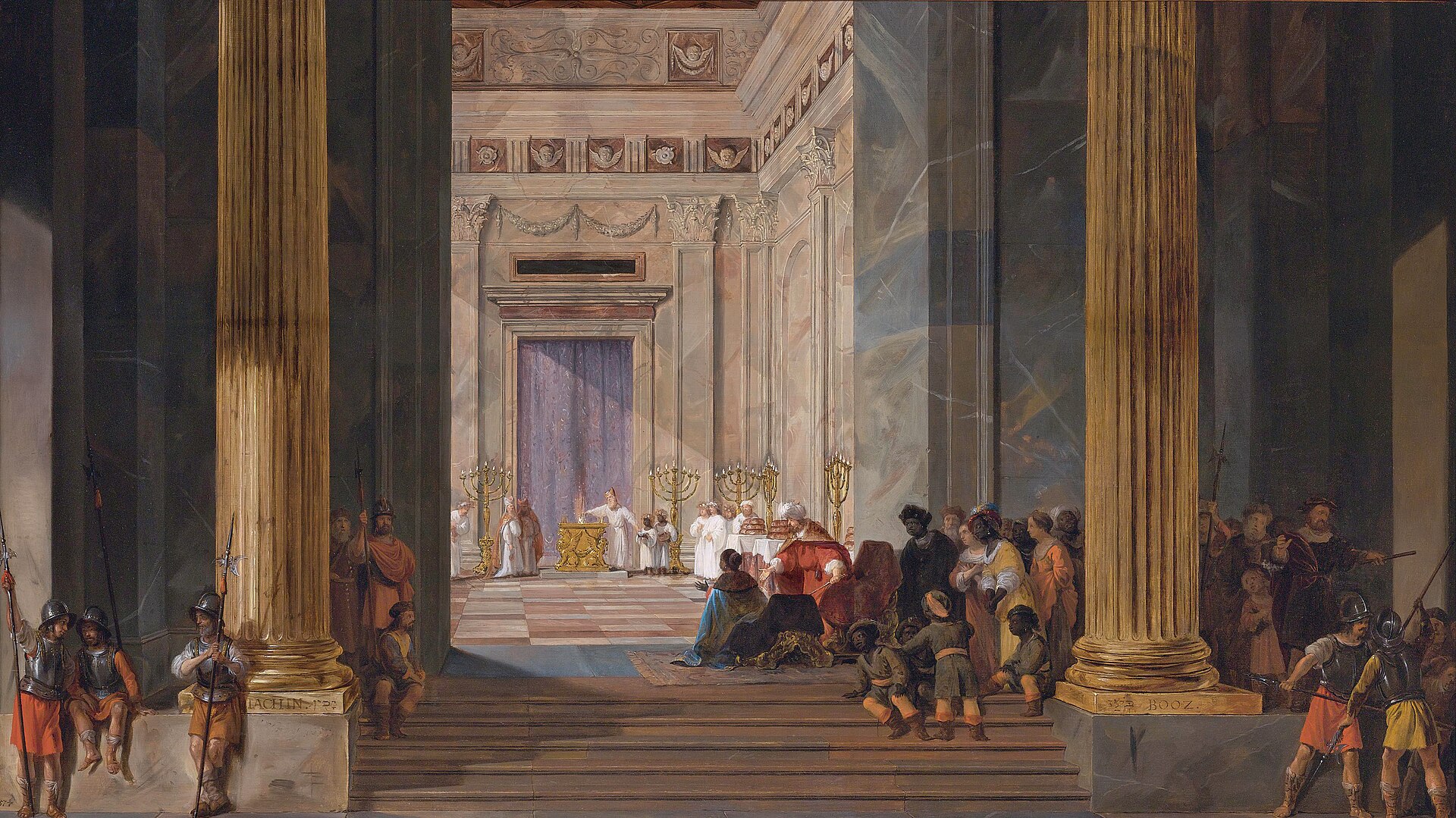
Great Solomon is a title no single verse of the Hebrew Bible ever uses, yet four largely separate traditions — Jewish scripture's own portrait of the king, the Qur'an's account of Sulayman, European Freemasonry's ritual symbolism, and the grimoire literature that later borrowed his name — each arrived independently at calling him exactly that. None of them were quoting the others. Each looked at a different slice of the Solomon legend and concluded the ordinary vocabulary of kingship was not sufficient for what they were describing. Understanding why means tracing four separate inheritances rather than one.
The Biblical Case: A King Whose Wisdom Outran His Era
The First Book of Kings never calls Solomon great, but it builds the case for the word on almost every page. It credits him with a request to God for an understanding heart rather than riches or long life, then shows that request answered so thoroughly that "all the earth sought the presence of Solomon, to hear his wisdom." It describes a court supplied by twelve districts in rotation, a navy that sailed to Ophir for gold, a Temple seven years in the building, and a reputation that drew the Queen of Sheba across a desert to test him with hard questions. None of this is the language of an ordinary monarch's annals. It is the language a later reader distills into a single adjective, because the text has already done the work of making the case for one.
That accumulation of superlatives is also why the throne itself became a flashpoint the moment his father died. The maneuvering that put Solomon on it in the first place — a half-brother's near-coup, a hurried anointing at a spring outside the city walls — is its own dramatic story, one we trace in full in our essay on how Solomon becomes king. The point worth carrying forward here is that nothing about his rise made greatness a foregone conclusion. The reputation that later generations compressed into "great" was earned across a reign, not assumed at its opening day.
Sulayman the Great: The Qur'an's Wider Portrait
Islamic tradition inherited the same historical figure but drew a considerably larger circle around him. The Qur'an's Sulayman is a prophet as well as a king, given understanding of the speech of birds, command over the wind, and authority over jinn pressed into service on his building projects — a scope of power well beyond anything the Hebrew Bible claims for its Solomon. Later Islamic scholarship frequently attaches the honorific al-'Azim, "the Great" or "the Mighty," precisely because the Qur'anic account already reads like the record of someone operating outside the normal boundaries available to a human ruler. The title, in other words, follows the text rather than inflating it.
What makes this strand of the tradition worth taking seriously on its own terms, rather than as an exotic variant of the biblical story, is how consistently it treats Sulayman's authority as a test rather than a trophy. The Qur'an frames his command over nature and spirits as a trial of gratitude, not an unqualified blessing — a frame the Hebrew narrative echoes in its own way, since Solomon's later chapters describe a wisdom that did not finally protect him from his own excesses. Two traditions, writing centuries apart in different languages, arrive at the same caution: greatness of this kind is a responsibility that can be failed as easily as it can be fulfilled.
Solomon the Great in Freemasonry's Ritual Symbolism
A third inheritance belongs to Freemasonry, which built an elaborate ritual vocabulary around Solomon's Temple centuries after any historical record could confirm the details. In Masonic ceremony, Solomon frequently appears styled as one of the three Grand Masters presiding over the Temple's construction, a title carrying the implicit sense of greatness even where the word itself is not always spelled out. Nineteenth-century scholars of the craft's own history, including Josef Schauberg's study of its Semitic names, argued that much of this symbolism layers later allegorical material over the biblical account rather than preserving any independent historical memory of the king.
That scholarly caution matters, because it clarifies what the Masonic title is actually doing. It is not a historical claim about how contemporaries addressed Solomon in his own lifetime. It is a ritual framework built to dramatize ideas about order, craftsmanship, and the transmission of knowledge, with Solomon cast as the figure large enough to carry that symbolic weight. The greatness here is theatrical and pedagogical before it is historical — which does not make it meaningless, only differently sourced than the biblical and Qur'anic material that came before it.
The Legendary Solomon: Where the Title Turns Into a Brand
The fourth strand is the strangest, and the one most prone to being misread. Centuries after Solomon's death, a Greek text called the Testament of Solomon began circulating a story in which the king is given a ring by the archangel Michael and uses it to bind a long procession of spirits to labor on the Temple. That single legend proved durable enough to spawn an entire later literature — grimoires such as the Key of Solomon, written in his name by authors living more than two thousand years after he did — that treated his reputed authority over spirits as a kind of brand to attach their own ceremonial systems to. These texts are worth studying as artifacts of medieval and early modern occult culture in their own right; they are not a record of anything the historical Solomon said or did, and the tradition this site describes reads the underlying legend as allegory about inner discipline rather than literal command over anything external.
It is worth being plain about why that distinction matters. A reader searching for "Great Solomon" sometimes lands here expecting a doorway into ceremonial practice. What the history actually offers is the opposite: a long chain of writers, separated by centuries and continents, each finding Solomon's story large enough to build their own claims on top of it. The pattern itself — how often later generations reached for his name specifically because it already carried an unusual weight — tells you more about why the title stuck than any single legend does.
What the Mystery Tradition Means by Solomon's Greatness
The mystery school tradition this site draws on reads all four inheritances but locates the actual substance of Solomon's greatness somewhere none of them quite names. It holds that the wisdom credited to Solomon was not cleverness in the ordinary sense, nor control over birds or spirits, but direct understanding of a structure the tradition claims underlies both the cosmos and the human being — the same structure later formalized in Kabbalah as the Tree of Life. In this reading, "great" describes a degree of inner mastery rather than a scale of worldly reach, which is also why the tradition insists that kind of understanding has always required guided study rather than a single dramatic revelation. We examine what that guided process actually looks like, and how to tell a genuine teacher from an empty promise, in our essay on spiritual awakening guidance.
Seen this way, the four historical strands are not competitors arguing over who gets to keep the word "great." They are four different audiences reaching for the same adjective because each, in its own idiom, recognized that an ordinary vocabulary of kingship could not hold what it was trying to describe. The Bible reached for it through wisdom literature and diplomacy. The Qur'an reached for it through command over nature and a moral test attached to that command. Freemasonry reached for it through ritual drama built around a vanished Temple. The grimoire tradition reached for it, less carefully, as a name worth borrowing. The mystery tradition reaches for it last, and argues that the honest version of the title was never about scale at all — it was about depth.
Walk the Path of the Initiate
These teachings come alive in The Initiated — Paul Schulz's introduction to the living mystery school tradition.
Get the BookFrequently Asked Questions
What does Great Solomon mean?
Great Solomon is an honorific applied to King Solomon by later tradition rather than a title the Hebrew Bible itself confers. It gathers together separate claims about his wisdom, wealth, and legendary authority from Jewish, Islamic, Masonic, and esoteric sources that developed independently of one another.
Why is Solomon called great in the Bible?
The Hebrew Bible never uses the word great as a formal title for Solomon. Instead, 1 Kings describes a king whose wisdom, wealth, building projects, and diplomatic reach so exceeded every other monarch of his age that later readers simply adopted the adjective as shorthand for the whole picture.
What does Islamic tradition say about Sulayman the Great?
The Qur'an presents Sulayman as a prophet-king given understanding of the speech of birds and command over the wind and jinn, a scope of authority considerably wider than the Bible's account. Islamic tradition frequently adds the honorific al-'Azim, meaning the Great or the Mighty, to mark that elevated status.
Is Great Solomon the same as the grimoire called the Key of Solomon?
No. The Key of Solomon, or Clavicula Salomonis, is a medieval and early modern grimoire written in Solomon's name many centuries after his lifetime. It borrows his legendary authority over spirits for its own purposes; it is a literary artifact of later ceremonial magic, not a record of the historical king or evidence for any title he actually held.
Did Solomon really command spirits?
No contemporary source makes that claim. The idea first appears centuries after Solomon's death in the Testament of Solomon, a pseudepigraphal text in which spirits are bound to labor on the Temple. The tradition treats the story as legend and allegory, not as a historical event or a literal power any person actually possessed.
What does the mystery school tradition mean when it calls Solomon great?
The mystery school tradition locates Solomon's greatness in a claimed line of initiate-to-initiate teaching reaching back to his reign, not in wealth, conquest, or command over spirits. In that reading, greatness names a quality of inner mastery and transmitted wisdom rather than worldly power.