Solomon in the Bible: The Full Story of Israel's Wisest King
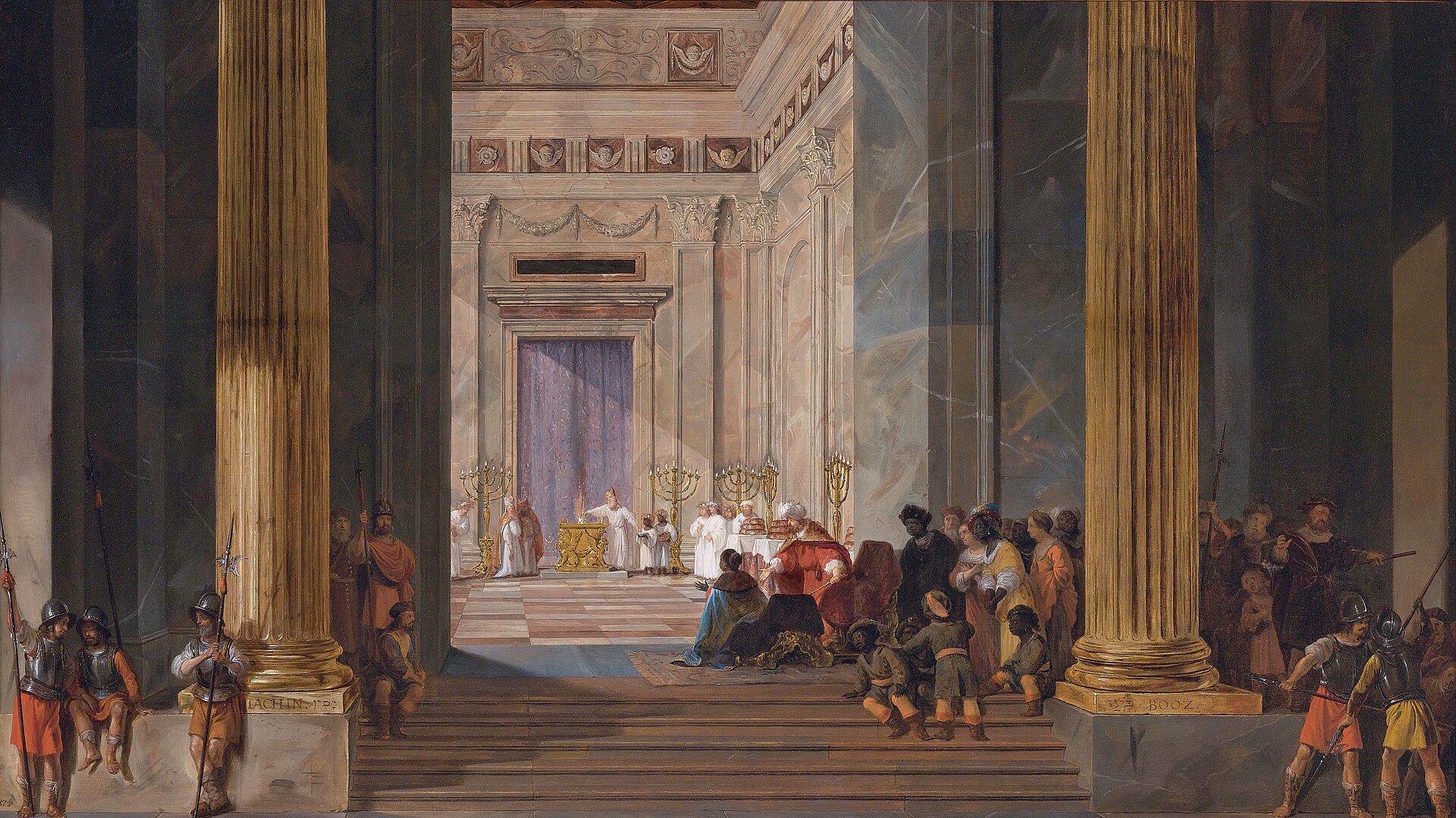
Solomon in the Bible is the son of David and Bathsheba, the third king of Israel, and the ruler credited with building the First Temple in Jerusalem — a reign the Hebrew scriptures present as the high point of Israel's power and, in its later chapters, as a cautionary tale of how that power was lost. His story spans four books: 2 Samuel, 1 Kings, 2 Chronicles, and the wisdom literature traditionally attributed to his pen. Read start to finish, it is not simply a success story. It is an arc — a rise into unmatched wisdom and wealth, followed by a slow drift away from the very discernment that made him great.
Solomon in the Bible: From Birth to the Throne
Solomon's origins are more complicated than his later reputation suggests. 2 Samuel 12 records that he was born to David and Bathsheba after their first child, conceived during David's affair with Bathsheba while she was still married to Uriah the Hittite, died in infancy as a consequence the text frames as divine judgment. Solomon's birth follows that loss directly, and the passage adds a detail easy to overlook: the prophet Nathan gave the infant a second name, Jedidiah, meaning "beloved of the Lord."
He was not David's eldest surviving son, and nothing in the succession made his kingship automatic. As David aged, his son Adonijah moved to claim the throne, gathering support and holding a coronation feast without his father's blessing, as told in 1 Kings 1. It was Bathsheba, prompted by Nathan, who went to the dying David and secured his promise that Solomon would reign. David acted quickly, having Solomon anointed and proclaimed king while Adonijah's feast was still underway. The throne Solomon inherited was won through court intrigue as much as birthright — a detail the text does not soften.
The Dream at Gibeon: Where Solomon's Wisdom Begins
Once secure in power, Solomon traveled to Gibeon to offer sacrifices, and there, in a dream, God asked what he wished to be given. His answer set the tone for everything that follows:
"Give therefore thy servant an understanding heart to judge thy people, that I may discern between good and bad." — 1 Kings 3:9
He asked for discernment rather than long life, riches, or victory over his enemies, and the narrative treats this choice itself as evidence of wisdom. God grants the request and, because Solomon did not ask for them, adds wealth and honor besides. The episode is deliberately placed at the start of his reign: everything Solomon later builds and possesses is framed as flowing from this one request, not preceding it.
Solomon in the Bible: Wisdom, Wealth, and the Building of the Temple
The chapters that follow catalogue Solomon's achievements at a scale meant to overwhelm the reader. He renders the celebrated judgment between two women disputing a child, a case so shrewdly resolved that "all Israel... feared the king: for they saw that the wisdom of God was in him" (1 Kings 3:28). He organizes the kingdom's administration, secures peace with neighboring powers, and — most consequentially — undertakes the building of the Temple in Jerusalem, described across 1 Kings 6–8 in exacting architectural detail: cedar from Lebanon, gold overlay, cherubim carved into the inner sanctuary, a seven-year construction described down to its cubits.
The Temple was more than a building project. In the biblical account it fulfills a promise made to David, who was told he would not build God's house but that his son would. It also functions as the visible center of Solomon's reign, drawing visitors like the Queen of Sheba, who came, scripture says, "to prove him with hard questions" and left declaring that the half had not been told her. The tradition Paul Schulz writes from reads Solomon's era as the point at which the hermetic principles governing correspondence between the visible and the invisible were most fully expressed in stone — the Temple as a deliberate mapping of cosmic order onto physical space, not merely a royal monument.
The Many Wives and the Beginning of Solomon's Decline
1 Kings 11 opens with a sentence that reverses everything that came before: "But king Solomon loved many strange women." The text lists seven hundred wives of royal rank and three hundred concubines, many secured through political marriages that sealed alliances with Egypt, Moab, Ammon, Edom, and other neighboring powers. The chapter is explicit about the mechanism of his fall — not a single dramatic act of betrayal, but an accumulation of foreign influence that, "when Solomon was old," turned his heart toward the gods his wives had brought with them: Ashtoreth of the Sidonians, Milcom of the Ammonites, Chemosh of Moab.
The consequence is stated without ambiguity: Solomon's heart "was not perfect with the Lord his God, as was the heart of David his father." God raises adversaries against him — Hadad the Edomite, Rezon of Damascus, and eventually Jeroboam, told directly by the prophet Ahijah that ten of the twelve tribes will be torn from Solomon's line. The judgment is deferred for David's sake, but not withdrawn. The same discernment Solomon asked for at Gibeon is what the narrative shows him losing, slowly, without one moment he could point to and call the turning point.
Ecclesiastes and the Reckoning of a King
Tradition places Ecclesiastes in Solomon's later years, and read alongside 1 Kings 11 it functions almost as an interior commentary on the same decline. Its narrator, the Preacher, tests wealth, pleasure, labor, and wisdom itself against the fact of mortality and finds each insufficient: "vanity of vanities; all is vanity." This is not the confident voice of the young king who built the Temple. It is the voice of a man who has had everything and discovered that having is not the same as being satisfied.
Later esoteric readers, including the anonymous authors behind the Kybalion, drew heavily on the idea that ancient kings and priest-initiates such as Solomon encoded higher teaching beneath plain narrative — that a text like Ecclesiastes could be read simultaneously as royal memoir and as instruction in detachment from outcome. Whether or not one accepts that reading, the plain text alone shows a king auditing his own life honestly, which is itself a rarer thing in scripture than triumph.
The Death of Solomon and the Divided Kingdom
Scripture gives Solomon's death remarkably little ceremony. 1 Kings 11:43 records only that "Solomon slept with his fathers, and was buried in the city of David his father: and Rehoboam his son reigned in his stead." The weight of the account falls instead on what happens next. Rehoboam, faced with a delegation asking him to lighten the labor burdens his father had imposed, chooses to increase them instead. Ten tribes revolt under Jeroboam, and the united kingdom Solomon inherited from David splits permanently into Israel in the north and Judah in the south — a rupture the text traces directly back to the compromises of Solomon's own reign.
What Solomon in the Bible Still Teaches
Taken as a whole, rather than stopped at its highest point, Solomon's story is less a portrait of a perfect king than a study in how discernment, once gained, still has to be guarded. The same man who asked for an understanding heart at Gibeon is the man whose heart, decades later, the text says was turned away. Within the mystery tradition, this full arc — rise and decline together — is treated as more instructive than the glory years alone, because it shows that wisdom is not a possession secured once and kept automatically. It is a practice that has to be renewed, choice by choice, against the steady pressure of comfort, power, and compromise.
Walk the Path of the Initiate
These teachings come alive in The Initiated — Paul Schulz's introduction to the living mystery school tradition.
Get the BookFrequently Asked Questions
Who was Solomon in the Bible?
Solomon was the third king of Israel, son of David and Bathsheba, who reigned roughly from 970 to 930 BCE. The Hebrew Bible credits him with unmatched wisdom, vast wealth, and the construction of the First Temple in Jerusalem. He is also named as the traditional author of Proverbs, Ecclesiastes, and the Song of Songs, and his reign is remembered as the high-water mark of the united kingdom of Israel.
Was Solomon the son of King David?
Yes. Solomon was born to David and Bathsheba after the death of their first child, as told in 2 Samuel 12. He was not David's eldest son, and his path to the throne required Bathsheba and the prophet Nathan to intervene on his behalf against his older half-brother Adonijah's attempt to seize the crown, recorded in 1 Kings 1.
Why did God become angry with Solomon?
According to 1 Kings 11, Solomon married many foreign wives who, in his old age, turned his heart toward the worship of their gods, including Ashtoreth and Chemosh. The text states plainly that his heart was no longer wholly devoted to the God of Israel, and as a consequence he was told the kingdom would be torn away from his son, though not during Solomon's own lifetime, for David's sake.
How many wives and concubines did Solomon have?
1 Kings 11:3 gives the figure of seven hundred wives of royal rank and three hundred concubines. Most scholars read this less as a literal census than as a rhetorical way of signaling the scale of Solomon's foreign alliances, since many of these marriages were diplomatic unions sealing treaties with neighboring kingdoms.
What books of the Bible did Solomon write?
Tradition attributes three biblical books to Solomon: Proverbs, associated with his practical wisdom as a young ruler; Song of Songs, a lyric celebration of love; and Ecclesiastes, a searching, often melancholy meditation on meaning and mortality usually placed in his later years. Modern scholarship debates the extent of his direct authorship, but the three books together read as a single arc from confidence to hard-won honesty.
How did Solomon in the Bible die?
Scripture gives no dramatic account of Solomon's death. 1 Kings 11:43 states simply that he slept with his fathers and was buried in the City of David, succeeded by his son Rehoboam. The narrative's real emphasis falls not on the death itself but on its aftermath: within a generation, the united kingdom Solomon inherited split permanently in two.