Solomon Secrets: What the Legends Actually Claim He Knew
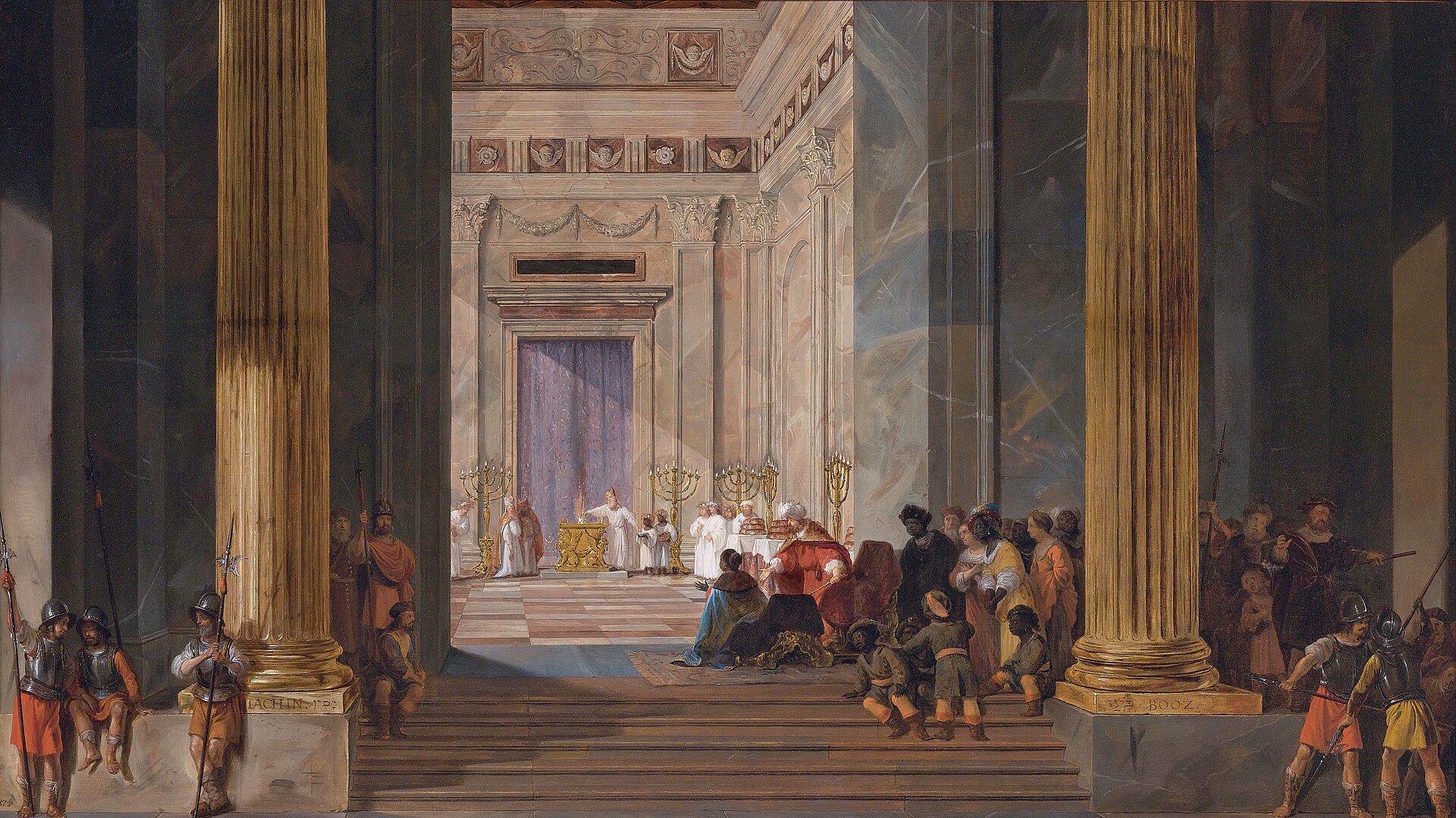
"Solomon secrets" is a search that collects at least three unrelated legends under one heading. One claims he held a ring that gave him command over seventy-two spirits. One claims a Masonic vault beneath his ruined Temple hid a sacred word lost for centuries. One claims something stranger still — that an unbroken chain of private teaching runs from his reign to living teachers today. None of them point to one hidden fact a reader can simply be handed. They are three different eras, writing three different stories onto the same wise king, each for its own reasons.
The Ring Legend: Solomon's Reputed Power Over Spirits
The oldest and most famous of the Solomon secrets is also the least historical. It comes from the Testament of Solomon, a text assembled somewhere between the first and fifth centuries CE and surviving only in medieval manuscripts, which presents itself as Solomon's own account of building the Jerusalem Temple. In it, the archangel Michael delivers a ring marked with a five-pointed star, the device later called the Seal of Solomon, and with it Solomon is said to have bound a long procession of troublesome spirits and set them to quarry stone and carry water until the Temple stood complete. It is a vivid story, and it is exactly that — a story, composed centuries after Solomon's death, never treated as scripture by any Jewish or Christian tradition that reads the Bible.
The legend did not stay contained. Later medieval and early modern writers built an entire literature on its premise, most notably the grimoires known as the Key of Solomon and the Lesser Key of Solomon, which formalized the idea of commanding named spirits into structured ceremonial systems bearing Solomon's name. Those texts are worth understanding as artifacts of their own centuries — products of Renaissance and early modern occult culture claiming an ancient king's authority — rather than as evidence of anything Solomon himself did. We cover the original legend and its afterlife in full in our essay on the Testament of Solomon, including how the mystery tradition reads the whole account as an allegory of inner discipline rather than literal power over demons.
Solomon Secrets and the Freemasons' Hidden Vault
A second, entirely separate legend belongs to Freemasonry rather than to Jewish or Christian pseudepigrapha. In the symbolism built around the Royal Arch degree, workmen clearing the site of the ruined Temple are said to have broken through to a concealed underground vault and recovered a sacred word that had been lost since the Temple's destruction scattered the original builders and their knowledge. The story is staged entirely around Hiram, the Temple's architect, who in Masonic ritual symbolism becomes a central figure of death and recovered knowledge — a role nineteenth-century scholars of Masonic history, including Josef Schauberg in his study of the craft's Semitic names, argued was layered over an older mythic figure of a dying and returning sun-god rather than a record of an actual historical person.
This legend is a lodge tradition, built up gradually from the eighteenth century onward as Masonic ritual elaborated its own symbolic history of Solomon's Temple. It has nothing to do with the mystery school lineage this site otherwise describes, and nothing in it describes an actual rite a reader could carry out — it is an allegory, told and retold inside Masonic ceremony, about knowledge that was lost and symbolically found again. Whatever the vault represents, it represents it the way a parable represents a truth: not as an artifact anyone could locate with a shovel, but as a teaching about recovery after rupture.
The Kabbalistic Secret Behind Solomon's Wisdom
A third strand of "Solomon secrets" comes from Kabbalah, which credits Solomon not with commanding spirits or hiding words underground but with mastering a map of consciousness and creation usually pictured as the Tree of Life. In this reading, the "wisdom" the Hebrew Bible attributes to Solomon — the capacity behind his famous judgments and his authorship of Proverbs and Ecclesiastes — was never merely cleverness. It was direct knowledge of the structure the Kabbalistic tradition claims underlies both the cosmos and the human being, the same structure later schools would formalize into the ten sephirot and the paths that connect them. The tradition insists this system transcends any single religion, treating it instead as a universal science of consciousness that happens to have reached the West through a Hebrew vocabulary.
Here, too, "secret" does not mean a formula withheld from the public out of malice or marketing. It means knowledge the tradition holds to require direct experience and guided study to be understood correctly — the same reason mathematics is not secret in the sense of being forbidden, yet still cannot be transmitted by a single sentence to someone who has not done the work of learning it.
The Mystery School's Own Claim: A Living Line, Not a Buried Object
The Modern Mystery School, the living lineage this site describes, makes a claim about Solomon that differs from all three legends above. It does not describe a magical ring, a lost word, or a withheld formula. It describes a line of direct, person-to-person transmission — teaching passed from an initiated teacher to a student, generation after generation, said to trace in written record more than three thousand years back to King Solomon and in oral tradition further still, to Hermes Trismegistus. According to the tradition's own account, this lineage survived by staying private, not because its content was forbidden, but because a line of transmission that depends on continuity does not advertise itself in eras hostile to it. It was only in 1997 that this lineage, carried by the teacher Gudni Gudnason, came forward publicly for the first time in its recorded history. We examine this specific claim, and what can and cannot be verified about it, at length in our essay on what a mystery school actually is.
Whether or not a reader accepts the claim of an unbroken chain reaching back three thousand years, the shape of the claim itself is instructive. It is the opposite of a treasure map. There is no object to dig up and no sentence that unlocks it from a page. What the tradition calls Solomon's actual legacy is a relationship — teacher to student, held and renewed across centuries — which is a far less dramatic story than a demon-binding ring, but a far more testable one: it is either still being taught by living people today, or it is not.
What "Solomon Secrets" Really Means Today
Put the three strands side by side and a pattern appears. The ring belongs to legend — a story about power, written centuries after the man it describes died, and later expanded into an entire literature of ceremonial magic that borrowed his name. The vault belongs to Masonic symbolism — a parable about knowledge lost and recovered, staged inside a fraternal ritual tradition with its own separate history. The Kabbalistic reading and the mystery school's lineage claim belong to a third category entirely: a living tradition that holds its deepest teaching is never secret in the sense of forbidden, only inaccessible without the discipline of direct study and initiation, the same way any serious body of knowledge resists being compressed into a single revealed answer.
None of this means the search for "Solomon secrets" was misplaced. It means the search finds three different kinds of truth depending on which door it opens — a story, an allegory, or a claim about a teaching lineage still operating in the present. Readers drawn to the third door are the ones the tradition considers its actual inheritors: not people hunting for a hidden object, but people willing to do the slower work a living transmission actually requires.
Walk the Path of the Initiate
These teachings come alive in The Initiated — Paul Schulz's introduction to the living mystery school tradition.
Get the BookFrequently Asked Questions
What are the secrets of Solomon?
There is no single secret of Solomon. The phrase gathers at least three separate legends: a magical ring said to give him control over seventy-two spirits, a Masonic legend of a hidden vault and a lost sacred word beneath his Temple, and a mystery school claim of an unbroken line of esoteric teaching passed down from his reign to today.
Did King Solomon really have a magical ring?
No contemporary source describes one. The ring appears centuries later in the Testament of Solomon, a pseudepigraphal Greek text composed between the first and fifth centuries CE, which says the archangel Michael gave Solomon a ring engraved with a five-pointed star that let him bind troublesome spirits to labor on the Temple. It is legend, not history, and is never presented as scripture by any tradition.
What is the Freemasons' secret vault connected to Solomon?
In Masonic legend tied to the Royal Arch degree, workers rebuilding the ruined Temple are said to have uncovered a hidden underground vault containing a long-lost sacred word, recovered after the destruction that scattered the original builders. Masonic historians generally read this as an allegory of recovered knowledge rather than an archaeological claim, built around the mythic figure of Hiram, the Temple's architect.
Are the Key of Solomon and the Lesser Key of Solomon the same as Solomon's own secrets?
No. The Key of Solomon (Clavicula Salomonis) and the Lesser Key of Solomon (Lemegeton) are medieval and early modern grimoires written in Solomon's name long after his lifetime. They borrow the premise of the earlier Testament of Solomon legend but are literary and historical artifacts of ceremonial magic, not a record of anything the historical king actually did or taught.
Is Solomon's secret wisdom still taught today?
The Modern Mystery School holds that the genuine secret is not a ring or a buried word but a line of direct, initiate-to-initiate transmission tracing back more than three thousand years to King Solomon, kept private for most of its history and brought into public view only in 1997. That claim of lineage, not any single magical object, is what the tradition itself calls Solomon's real legacy.