Solomon's Table: What 1 Kings Records, and the Legendary Table of Jerusalem
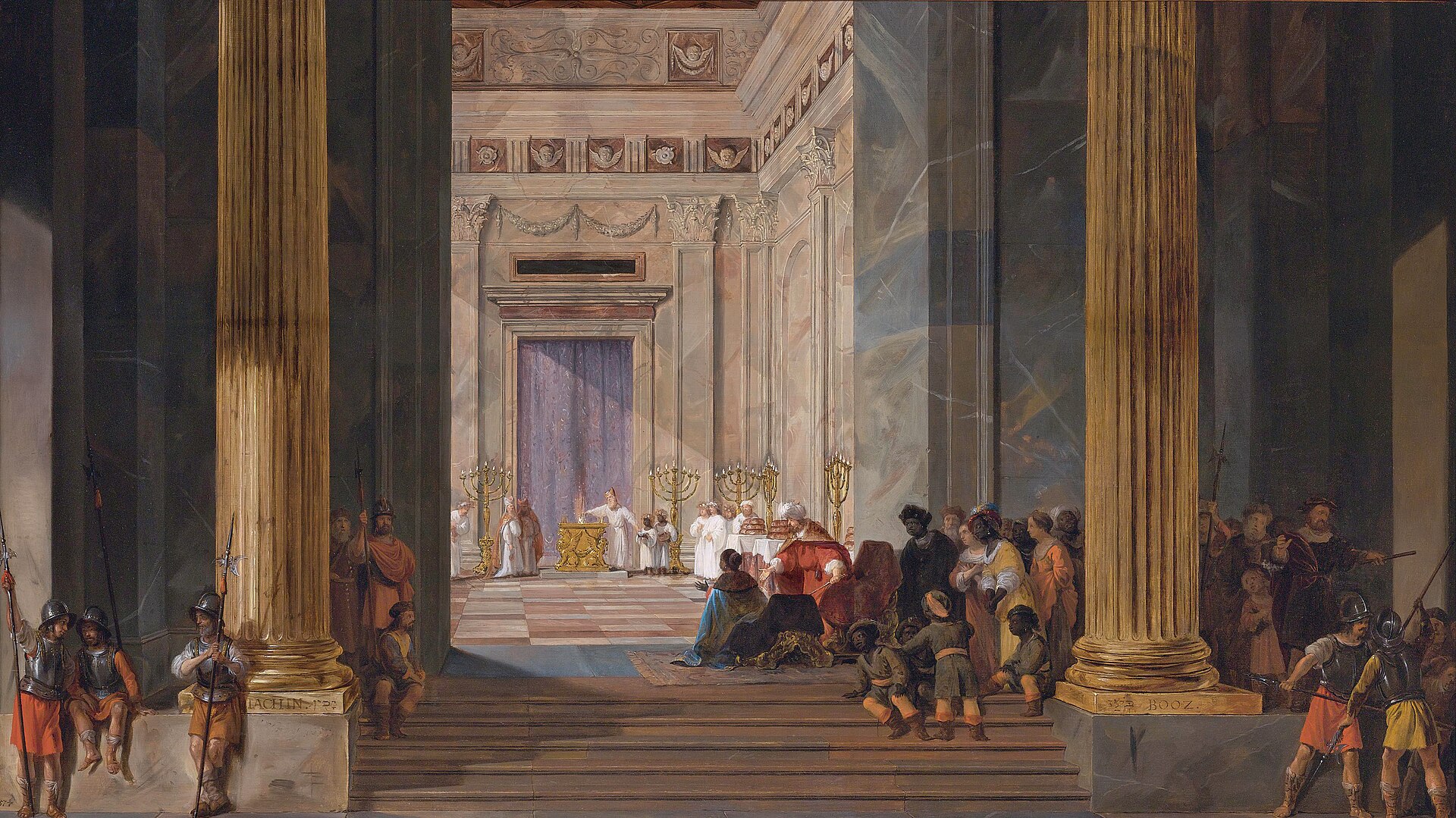
Solomon's table names two different things, and both are documented rather than invented. In the Bible, it is the staggering daily provision list set out in 1 Kings 4 — enough flour, cattle, and fowl delivered every single day to feed a small city, a detail the text treats as ordinary administration rather than miracle. In medieval legend, it is a specific object: a jeweled banquet table said to have come out of Solomon's Temple, carried through centuries of conquest, and seized in Spain in 711 CE. The two stories share a king and a word and very little else, and both are worth reading on their own terms rather than blending into a single vague image of royal luxury.
What 1 Kings 4 Actually Lists on Solomon's Table
The core record is one of the most specific logistical passages in the Hebrew Bible:
"And Solomon's provision for one day was thirty measures of fine flour, and threescore measures of meal, Ten fat oxen, and twenty oxen out of the pastures, and an hundred sheep, beside harts, and roebucks, and fallowdeer, and fatted fowl." — 1 Kings 4:22-23, KJV
That is a single day's accounting, not a lifetime total or a single feast. Scholars estimate the flour measures alone at roughly 150 bushels of fine flour and 300 of meal by modern reckoning, enough to bake bread for a household that, by the surrounding chapter's own count, ran into the thousands once guards, officials, scribes, and their families are added to the king himself. The text does not frame this as extravagance for its own sake; it sits inside a chapter cataloguing Solomon's administration — his officials, his territorial divisions, his horses, his peace with neighboring kingdoms — as one more line item in a functioning state. Solomon's table, read this way, is less a boast than a balance sheet, and a telling one: a kingdom at peace feeding itself at this scale was itself a form of evidence for the "rest on every side" the chapter claims for his reign.
Twelve Officers and a Kingdom Fed
A table of that size does not run itself, and 1 Kings 4:7-19 names the system built to supply it. Solomon divided the kingdom into twelve districts, each under an officer responsible for provisioning the royal household for one month of the year — a rotating national tax paid in food rather than coin. The officers are listed by name and territory, down to specific towns and the sons-in-law and household officials who held several of the posts, which is unusual detail for a text generally content to summarize. The arrangement meant no single region bore the full weight of the court's appetite for more than a month at a stretch, and it meant the king's table was, in effect, the entire kingdom's harvest made visible one course at a time. It is a small but genuine piece of ancient administrative engineering, and it is the part of the Solomon's-table story that modern readers, fixated on the quantities, most often skip past.
Solomon's Table Through the Queen of Sheba's Eyes
Scripture records at least one outside witness to all this, and her reaction is the detail later generations remembered. 2 Chronicles 9:3-4 reports that when the Queen of Sheba toured Solomon's court, she took in "the house that he had built, and the meat of his table, and the sitting of his servants, and the attendance of his ministers" — and the chapter says plainly that "there was no more spirit in her." The meat of his table sits in that list beside his wisdom, his Temple, and his retinue, as one more proof among several that the reports she had heard before traveling had, if anything, understated the reality. That visit and everything the tradition makes of it afterward is told in full in the essay on Sheba and Solomon; what matters here is narrower — that the king's table functioned, in the text's own narrative logic, as a kind of credential. A visiting sovereign could inspect an army or a treasury and be told what she was seeing. A table either fed a court at this scale in front of her or it did not.
The Legendary Table of Jerusalem: From Temple Treasure to Toledo
A second, very different "table of Solomon" enters the record centuries later, in the Arabic chronicles that describe the Muslim conquest of Spain. Writers such as Ibn Abd al-Hakam, compiling their accounts in the ninth century, describe a magnificent jeweled table — the Mesa de Salomón — among the royal treasure held by the Visigothic kings at Toledo. According to the legend these chronicles preserve, the table had originated in Solomon's Temple in Jerusalem, passed into Roman hands after the Temple's destruction in 70 CE, and from Rome eventually reached the Visigoths, who ruled Spain for roughly three centuries before the conquest. When the Umayyad commander Tariq ibn Ziyad took Toledo in 711, the chronicles say his forces captured the table along with the rest of the Visigothic treasury and sent it on to the caliph al-Walid I in Damascus as a trophy of the campaign.
Historians generally treat the table's claimed origin in Solomon's Temple as legend attached to a genuine, or at least genuinely rumored, treasure object — the same kind of layering that gives the Kebra Nagast's account of the Ark of the Covenant its narrative force. No source closer to Solomon's own era mentions a table of this description, and the chain connecting Jerusalem to Rome to Toledo rests entirely on chronicles written hundreds of years after the events they describe, serving the conquest's own need for a story worth telling. That does not make the legend empty. It reflects a recurring pattern in how later ages have handled Solomon's memory: an administrative detail from scripture — a king's provisioning, a king's wealth — is carried forward, concentrated into a single dazzling object, and relocated wherever the next storyteller's own history needed grounding in something older than itself.
How the Mystery Tradition Reads the Abundance of Solomon's Table
Within the initiatory lineage Paul Schulz teaches, Solomon's table is read the same way the tradition reads his gold, covered at length in the essay on King Solomon's treasure: as the visible overflow of an inward order, not as the point of the teaching itself. The tradition holds that a table set without scarcity reflects a mind no longer organized around lack — that provision on this scale, administered calmly across twelve districts rather than hoarded, is what wisdom looks like once it reaches the level of a whole household or a whole kingdom. Hospitality, in this reading, is not a side effect of wealth but one of its clearest tests: a ruler, or a person, whose abundance narrows rather than widens what others receive has not actually understood the principle Solomon's reign is remembered for demonstrating. Initiates describe the daily provision list in 1 Kings 4 less as a record of excess and more as a record of order extended outward until it fed everyone within reach of the throne — and they read the later legend of the jeweled table the same way the tradition reads most embellishment on Solomon's story: as proof of how durable the original image of his abundance became, long after the details of what actually sat on the table were lost to history.
What endures from both versions of the story is a single, plain observation. Solomon's table, whether counted in oxen and measures of flour or imagined as a single bejeweled relic worth fighting over for a thousand years, was never remembered for its taste or its craftsmanship. It was remembered because it worked — because a kingdom, a court, and a curious visiting queen could all look at it and see, without needing to be told, that the man who kept it understood something about order that most rulers never do.
Walk the Path of the Initiate
These teachings come alive in The Initiated — Paul Schulz's introduction to the living mystery school tradition.
Get the BookFrequently Asked Questions
What does "Solomon's table" mean in the Bible?
It refers to the daily provisions recorded for Solomon's royal household in 1 Kings 4:22-23 — an enormous quantity of flour, cattle, sheep, and game delivered every single day. The phrase also echoes 2 Chronicles 9:4, which lists "the meat of his table" among the things that left the visiting Queen of Sheba breathless, alongside his wisdom and his Temple.
What food was served at Solomon's table?
1 Kings 4:22-23 lists thirty measures of fine flour and sixty measures of meal, ten fattened oxen, twenty pasture-fed oxen, a hundred sheep, plus harts, roebucks, fallow deer, and fatted fowl — all of it as a single day's provision for the royal household, not a one-time banquet.
Was there a real, physical Table of Solomon?
Medieval Arabic chronicles describe a jeweled banquet table, the Mesa de Salomón, held among the Visigothic kings' treasure in Toledo and said to have originated in Solomon's Temple. Historians treat the object's biblical origin as legend layered onto a treasure that may well have existed in some form; no verse in the Bible itself names or describes such a table.
What happened to the Table of Solomon after the Muslim conquest of Spain?
According to the Arabic chronicles that record the story, the commander Tariq ibn Ziyad seized the table from the Visigothic treasury at Toledo during the conquest of 711 CE and sent it to the Umayyad caliph al-Walid I in Damascus as part of the campaign's spoils.
What does the mystery tradition say about Solomon's table?
The tradition reads the abundance of Solomon's table the same way it reads his gold: as the visible overflow of an inward order, not the point of the teaching itself. A table set without scarcity, initiates hold, mirrors a mind no longer governed by it — hospitality and provision as evidence of wisdom already established, not as the goal of seeking it.