The Hermetic Principle: The Master Law Behind the Other Six
The Hermetic Principle, spoken of in the singular, almost always means one specific teaching: Mentalism, the claim that "All is Mind" and that the universe itself is a mental creation. It is not a stand-in phrase for the seven hermetic principles as a set. It names the one principle among the seven that the Kybalion itself singles out as foundational — the law the other six are said to depend on rather than stand beside as equals. Understanding why one principle earns the definite article, while the rest share the plural, is the fastest way into the whole system.
Why People Call It "The" Hermetic Principle
Search for "hermetic principles" and you land on a list of seven: Mentalism, Correspondence, Vibration, Polarity, Rhythm, Cause and Effect, and Gender. Search for "the Hermetic Principle," singular, and the phrase usually points somewhere narrower — toward the first item on that list, and toward a specific claim the 1908 text called The Kybalion makes about it. The book states plainly that the principles of truth are seven, and that whoever grasps and understands them holds what it calls a master key. But it does not treat the seven as a flat, interchangeable set. It opens with Mentalism and returns to it constantly, using it to explain why the other six behave the way they do. That asymmetry is the reason the singular phrase persists: readers and teachers alike have long shorthanded "the" principle to mean the one doing the explanatory work for all the others.
This is a real distinction, not a pedantic one. Confusing "the Hermetic Principle" with "the hermetic principles" leads people to treat all seven as though they carry equal weight and independent authority. They do not, on the tradition's own account. Six of them describe patterns. One of them explains why those patterns exist at all.
Mentalism: The Principle the Other Six Depend On
The Principle of Mentalism holds that THE ALL — the substantial reality underlying every material appearance — is itself Spirit, and that the entire phenomenal universe is a mental creation existing within that infinite mind. Matter, energy, force, and the countless objects built from them are not, on this view, a separate order of being running alongside mind. They are mind's own production, governed by the same laws a mind imposes on its own creations.
Once that claim is granted, the other six principles stop looking like six unrelated observations about nature and start looking like six consequences of one premise. Correspondence — "as above, so below" — makes sense as a working law only if reality has a single mental substance running through every level, so that a pattern on one plane genuinely echoes a pattern on another rather than merely resembling it by coincidence. Vibration, Polarity, Rhythm, and Cause and Effect describe how that mental substance behaves in motion: nothing at rest, everything with its opposite pole, everything swinging between them, nothing outside the reach of law. Gender describes structure within that motion — the masculine and feminine principle the tradition holds is present in generation on every plane, mental and spiritual as well as physical. Strip away Mentalism, and each of the remaining six becomes an isolated curiosity. Keep it, and they read as one coherent argument.
This is what the Kybalion means by calling comprehension of this principle a master key: not that the other six become unnecessary, but that they become legible. A locksmith's master key does not replace the other locks in the building; it is simply the one key that explains why all the others were cut to the pattern they were.
Where the Phrase Comes From
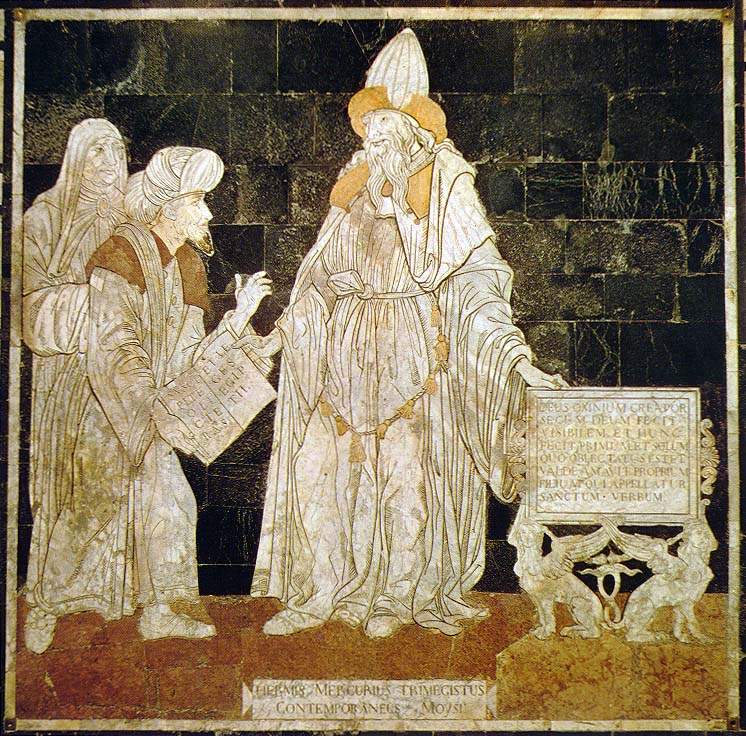
The Hermetic Principle, as a phrase and as a doctrine, enters modern usage through The Kybalion, published anonymously in 1908 by a group identifying themselves only as Three Initiates. The book presents itself not as an invention but as a restatement — a compressed, modern-English rendering of teachings the authors attributed to Hermes Trismegistus, the legendary "thrice-great" sage the Greeks identified with the Egyptian god Thoth, and to the broader body of writing known as the Corpus Hermeticum. Whether that lineage is read as literal history or as a literary framing device, the claim inside the text is consistent: Mentalism is not a modern philosophical addition bolted onto older material, but the oldest and central teaching the rest of the system was built to unfold.
Readers who want the fuller picture of that text — its structure, its seven principles side by side, and how the tradition actually applies them — will find it laid out in full in what the Kybalion actually teaches. The point worth carrying forward here is narrower: among everything that book contains, one claim is doing more foundational work than the rest, and that claim is what "the Hermetic Principle" names.
A Master Key, Not a Slogan
It is easy to flatten Mentalism into a bumper-sticker version of itself — "thoughts create reality," repeated until it means nothing in particular. The original claim is more exacting than that. It does not say that a person's individual thoughts rearrange the physical world on command. It says that the universe as a whole exists within, and is subject to the laws of, a mind vastly larger than any individual one — and that human mentality, being of the same essential nature as that larger mind, can come to understand and work intelligently with the laws governing it, rather than being pushed around by forces it cannot name. The tradition frames this understanding as the beginning of what it calls mastery: not power over circumstance by wish alone, but the capacity to recognize which of the seven principles is operating in a given situation, and to respond to it with comprehension instead of confusion.
That distinction matters for anyone comparing the Hermetic Principle to more recent popular teachings about mind and manifestation. The older text is careful, almost legalistic, about causation: it insists repeatedly that nothing escapes the Principle of Cause and Effect, that chance is only a name for a cause not yet recognized, and that even the higher planes of causation remain planes of law rather than planes of pure wish. Mentalism licenses no shortcut around Cause and Effect. It explains, instead, why Cause and Effect is a mental law rather than merely a mechanical one, and why a mind that understands its own vibration and polarity is better positioned to work with law, not against it.
The Hermetic Principle in the Mystery School Tradition Today
Living initiatory lineages that carry this material forward continue to open with Mentalism for the same reason the Kybalion does: everything taught afterward assumes it. A student who has not sat with the claim that reality is fundamentally mental will hear the seven hermeticism principles as seven separate rules to memorize, applied one at a time as circumstance seems to require. A student who has genuinely worked through Mentalism first tends to hear the same seven principles differently — as one continuous description of a single kind of universe, examined from seven angles.
Teachers in this tradition are careful to distinguish serious study of the principle from casual affirmation culture. The Kybalion itself warns against treating knowledge as something merely to be collected rather than used, comparing unapplied learning to hoarded metal that helps no one. The instruction the tradition draws from that warning is not a technique to perform, but an orientation to hold: approach the claim that "All is Mind" as something to be tested against experience over time, held with the same patience the seven principles themselves describe as characteristic of the rhythm and cause running through every serious course of study.
Walk the Path of the Initiate
These teachings come alive in The Initiated — Paul Schulz's introduction to the living mystery school tradition.
Get the BookFrequently Asked Questions
What is the Hermetic Principle, exactly?
When people search for "the Hermetic Principle" in the singular, they are almost always asking about Mentalism, the teaching that "All is Mind" — the one of the Kybalion's seven principles the text presents as foundational to the other six.
Is the Hermetic Principle the same as the seven hermetic principles?
No, though the phrases get used loosely. The seven hermetic principles are Mentalism, Correspondence, Vibration, Polarity, Rhythm, Cause and Effect, and Gender. "The Hermetic Principle," singular, refers specifically to Mentalism, the one the Kybalion calls the master key to the rest.
Why does the Kybalion call Mentalism a master key?
Because the text presents the other six principles as descriptions of how a mental universe behaves, not as independent laws. Correspondence, Vibration, Polarity, Rhythm, Cause and Effect, and Gender are framed as patterns within mind, so understanding Mentalism first is meant to make the rest legible rather than arbitrary.
Where does the Hermetic Principle come from historically?
The phrase traces to The Kybalion, published anonymously in 1908 by writers identifying themselves only as "Three Initiates," who presented the principle as a compressed restatement of a much older tradition attributed to Hermes Trismegistus and the Corpus Hermeticum.
Do modern mystery schools still teach the Hermetic Principle?
Yes. Contemporary initiatory lineages continue to present Mentalism as the entry point of hermetic study, treating it as a claim to be examined seriously rather than a slogan to be repeated.