Biblical King Solomon: What the Law of the King Reveals About His Reign
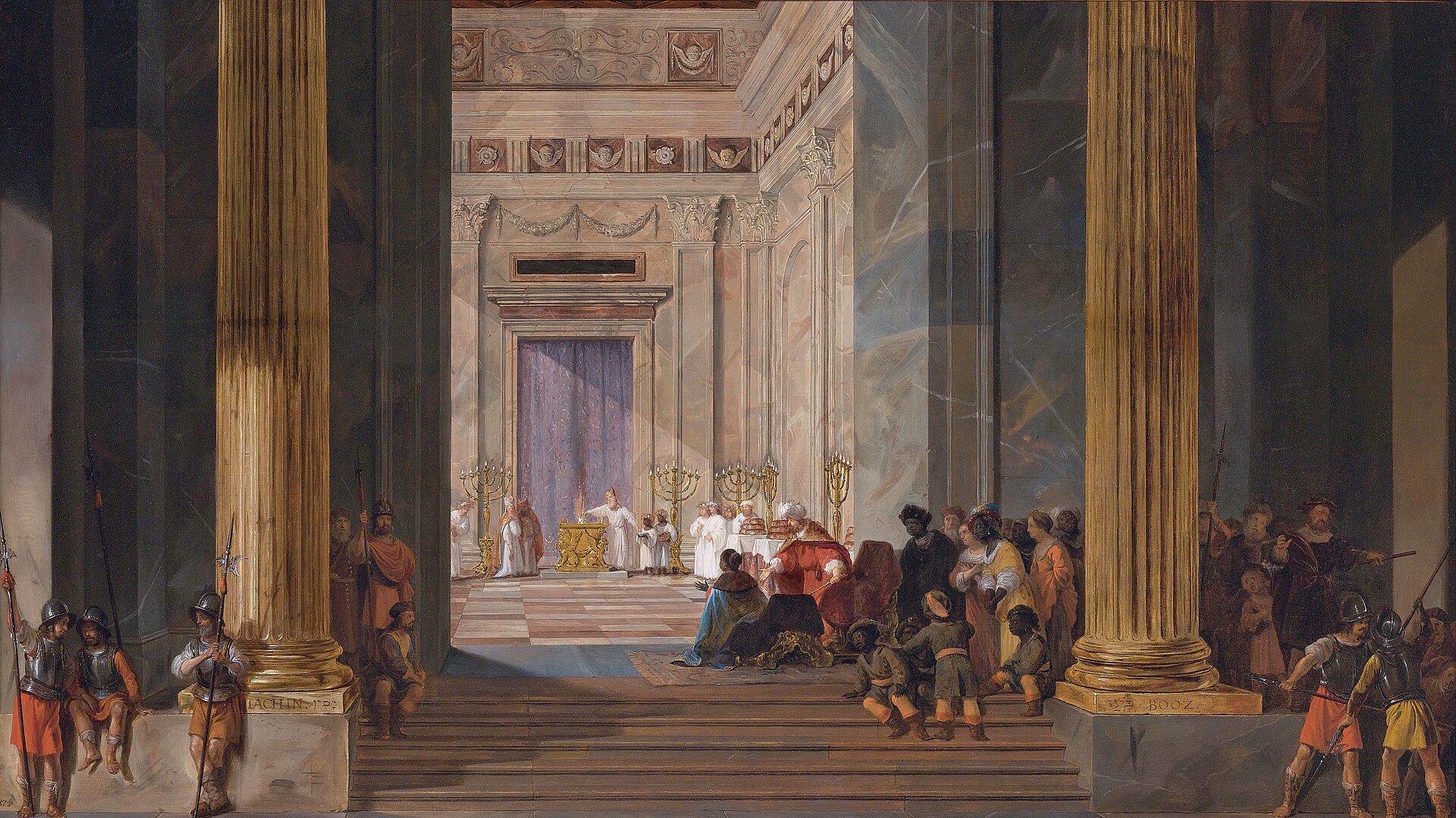
Biblical king Solomon was Israel's third monarch, son of David and Bathsheba, remembered for wisdom, wealth, and the Temple he raised in Jerusalem — but the word "biblical" attached to his kingship carries more weight than biography alone. Centuries before Solomon ever took the throne, the Torah had already written down an explicit law governing what a king of Israel could and could not do, in Deuteronomy 17:14-20. Solomon's reign became the great test case for that law: a lifetime that fulfilled its spirit in judgment and discernment while breaking its letter, point by point, in horses, wives, and gold.
The Law of the King, Written Before Biblical King Solomon Ever Reigned
Deuteronomy 17 does something unusual for an ancient legal text: it restricts an office that does not yet exist. Moses tells Israel that when they eventually ask for "a king over me, like as all the nations that are about me," three specific limits will apply. The king must not multiply horses to himself, "nor cause the people to return to Egypt, to the end that he should multiply horses." He must not multiply wives to himself, "that his heart turn not away." And he must not "greatly multiply to himself silver and gold." He is further commanded to write out a copy of the law by his own hand and read it every day of his life, "that his heart be not lifted up above his brethren."
This is not a description of a bad king written after the fact. It is a preemptive restraint, drafted generations before Saul, David, or Solomon ever sat on a throne, aimed squarely at the temptations that royal power reliably produces: military dependency, dynastic excess, and accumulated wealth. Read this way, biblical king Solomon's story is not simply a biography — it is a controlled experiment the text sets up in advance, and then watches play out.
The Throne of the LORD: Kingship as Stewardship, Not Sovereignty
1 Chronicles 29:23 states the theology behind the law plainly: "Then Solomon sat on the throne of the LORD as king instead of David his father." Not his own throne. The LORD's throne, occupied on divine terms. This distinguishes Israel's kingship sharply from the surrounding monarchies of the ancient Near East, where kings frequently claimed outright divine status or unlimited personal authority over their kingdoms. A steward who occupies someone else's throne can be bound by conditions in a way an absolute sovereign cannot, and that distinction is exactly what makes the law of the king possible in the first place.
The mystery tradition reads this framing as an early, plain-spoken statement of a principle initiates are trained to hold onto at every level of authority: power held in trust is answerable; power assumed as personal possession corrupts the one who assumes it. Solomon's reign becomes instructive precisely because he embodies both halves of that lesson inside a single lifetime.
Where Biblical King Solomon Fulfilled the Pattern
Early in his reign, Solomon models the law's ideal almost exactly. At Gibeon, offered anything by God in a dream, he asks not for long life, riches, or victory, but "an understanding heart to judge thy people, that I may discern between good and bad" (1 Kings 3:9). The request itself is an act of the humility Deuteronomy 17 demands — a king declining to place himself above his people even when granted the chance. The judgment between the two women disputing a child follows soon after, resolved with a shrewdness that leaves "all Israel" in awe of "the wisdom of God" in him (1 Kings 3:28). Scripture later summarizes the result: his wisdom "excelled the wisdom of all the children of the east country" (1 Kings 4:30), and the Temple he built stood as the visible center of a kingdom at peace with its neighbors.
Where Biblical King Solomon Broke the Law of the King
The same books that record this early fidelity also record, in strikingly precise language, its later collapse — echoing the law's own vocabulary closely enough that the parallel reads as deliberate rather than accidental. 1 Kings 10:28-29 states that Solomon's horses were imported by way of Egypt, naming the exact country Deuteronomy 17 had singled out as forbidden territory for exactly this purpose. 1 Kings 11:3 records seven hundred wives of royal rank and three hundred concubines, and the text does not leave the consequence to inference: "his wives turned away his heart," the very outcome the law had warned against by name. And 1 Kings 10:14 puts the gold that reached Solomon each year at six hundred sixty-six talents, an accumulation the law had explicitly capped before he was ever born.
Three restrictions, three violations, using nearly the same words each time. Whatever else this pattern is, it is not a coincidence of unrelated events; it reads as scripture inviting its audience to notice exactly where the king it once called wise stopped guarding the conditions of his own office.
The Conditional Covenant of 1 Kings 9
After the Temple's dedication, God speaks to Solomon again, and this time the promise comes with an explicit condition attached:
"But if ye shall at all turn from following me... then will I cut off Israel out of the land which I have given them." — 1 Kings 9:6-7
Even for the man who built God's house, the covenant of biblical kingship was never unconditional. This warning arrives before the downfall of 1 Kings 11, not after, which means the text has already told its reader what is coming — the law was stated, the condition was restated, and biblical king Solomon still moved toward violating both, one accumulation at a time.
What Biblical King Solomon Still Teaches About Power
None of the law's three restrictions were ever really about horses, wives, or gold as such. They were named because each one is what unchecked royal power naturally reaches for first — military strength, dynastic alliance, and treasure — and each one, left unguarded, erodes exactly the discernment Solomon once asked God for at Gibeon. His reign is remembered as the paradigm not because he avoided that erosion, but because scripture shows him experiencing both sides of the law within one life: the humility that kept it, and the appetite that broke it. For the fuller arc from his birth to the kingdom's division, that story is traced in Solomon in the Bible: The Full Story of Israel's Wisest King; for how this same king appears across the rest of scripture beyond Kings and Chronicles, see Bible King Solomon: Every Book Where He Appears in Scripture.
The tradition Paul Schulz writes from treats the law of the king less as ancient statecraft than as an instruction in self-governance still worth reading today: authority of any kind, once granted, does not enforce its own limits. Something has to. Biblical king Solomon's life is the Bible's own demonstration of what happens, for good and for ill, when that something is present at the start of a reign and quietly absent by its end.
Walk the Path of the Initiate
These teachings come alive in The Initiated — Paul Schulz's introduction to the living mystery school tradition.
Get the BookFrequently Asked Questions
What does "biblical king" mean when applied to Solomon?
It signals that Solomon's kingship was never treated in scripture as ordinary politics. Centuries before he reigned, Deuteronomy 17:14-20 had already laid down an explicit law restricting what any king of Israel could do, and 1 Chronicles 29:23 states that Solomon "sat on the throne of the LORD as king" rather than simply inheriting his father's crown. Being a biblical king meant holding delegated authority under specific, written conditions, not sovereign power in its own right.
What is the law of the king in Deuteronomy 17?
Deuteronomy 17:14-20 anticipates Israel asking for a king and sets three specific limits before the monarchy even exists: he must not multiply horses to himself, especially by returning the people to Egypt to acquire them; he must not multiply wives to himself, lest his heart turn away; and he must not greatly multiply silver and gold to himself. He is also commanded to keep a personal copy of the law and read it all his days, so that his heart is not lifted above his brethren.
Did biblical king Solomon actually break the law of the king?
In precise, textual terms, yes. 1 Kings 10:28-29 describes Solomon importing horses from Egypt by name, the exact scenario the law forbids. 1 Kings 11:3 records seven hundred wives and three hundred concubines, explicitly said to have turned his heart from God. 1 Kings 10:14 puts the gold reaching him each year at six hundred sixty-six talents. Each detail echoes the law's specific vocabulary closely enough that many readers take it as a deliberate signal rather than coincidence.
Why does the Bible say Solomon sat on the throne of the LORD?
1 Chronicles 29:23 uses this language to distinguish Israel's kingship from surrounding Near Eastern monarchies, where kings often claimed divine status outright. Solomon's throne is described as God's own throne, held on His behalf rather than owned outright, which is why the law of the king could impose real conditions on him. A steward can be held to terms in a way an absolute sovereign cannot.
Is Solomon's reign as a biblical king historically confirmed?
Solomon's reign, usually dated around 970 to 930 BCE, is far better attested within scripture's own literary and legal framework than in independent archaeological records, which remain debated for this specific period. Within the biblical text itself, however, his reign functions as settled history and as the primary case study for how the Torah's law of the king plays out in practice.